


Privacy regulations and competition law are rewriting programmatic advertising at the same time. One decides which data can enter the auction. The other decides who gets to run it.
Two years ago, most adtech roadmaps had one date circled: the end of third-party cookies in Chrome. That date never arrived. In April 2025, Google confirmed it would keep its current approach to third-party cookies in Chrome. Six months later, it retired several Privacy Sandbox technologies, citing low adoption, while keeping other privacy-related APIs.
The industry got its old signals back. Then it lost its footing somewhere else: in state legislatures, in EU councils and in a Virginia courtroom.
What Is Changing in the AdTech Landscape in 2026?
Programmatic advertising runs on signals and access. Signals tell a buyer who is on the other side of the screen. Access decides which exchanges and ad servers can compete for that impression. In 2026, both are being renegotiated.
Area | Before | In 2026 |
Third-party cookies | Expected to leave Chrome | Still in Chrome; several Privacy Sandbox APIs retired |
U.S. privacy laws | Fewer states covered | Indiana, Kentucky and Rhode Island in force; Oklahoma and Alabama from 2027 |
Opt-out signals | Often ignored | Required by at least a dozen state laws |
EU cookie consent | Split between GDPR and ePrivacy | Digital Omnibus would move it into the GDPR |
Google AdX | Tied to Google's own ad server | Ordered to connect to Prebid and bid into rival ad servers; implementation pending |
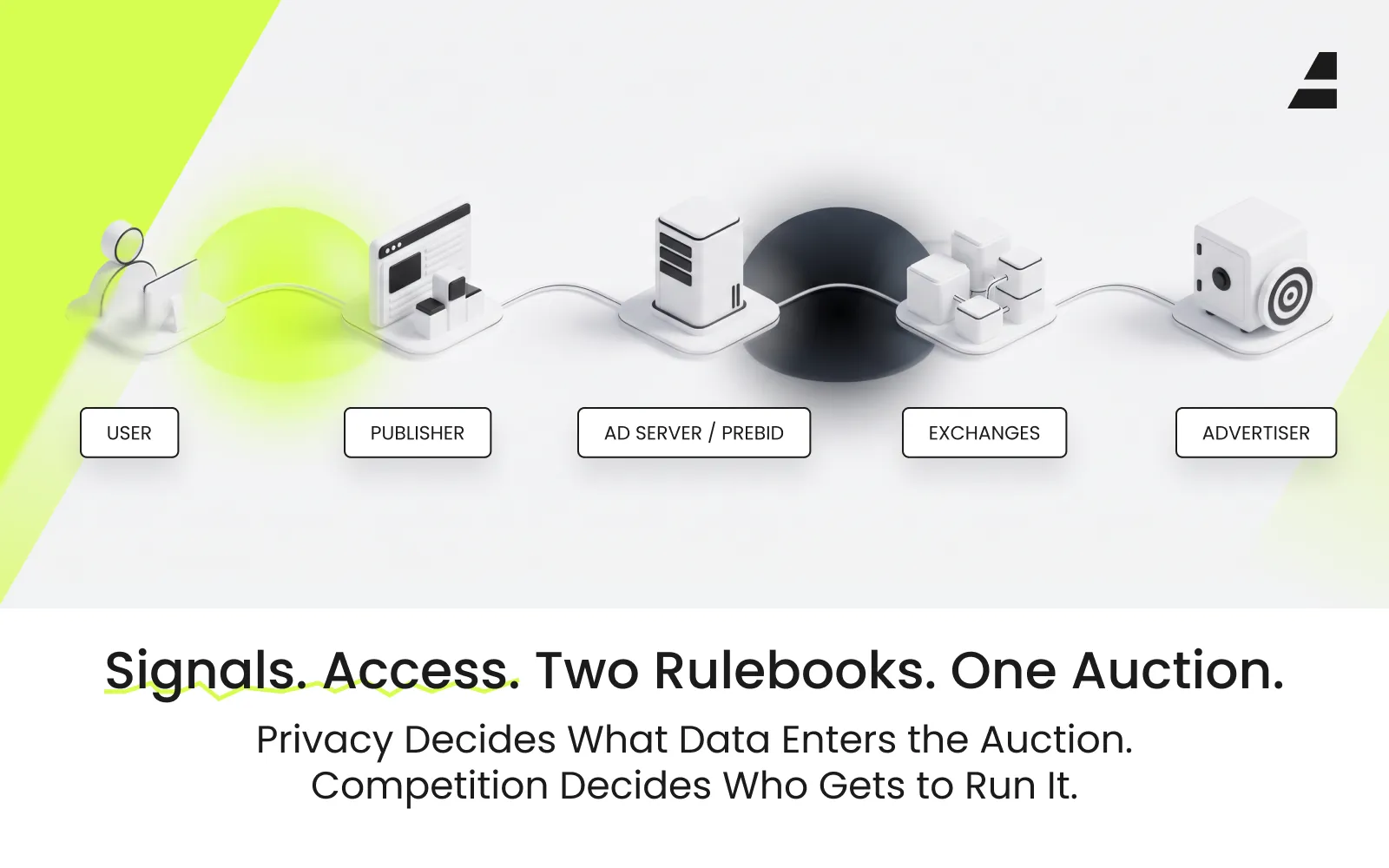
Programmatic auction flow showing where privacy signals and competition access apply. Privacy regulations and Google ad tech remedies changing how programmatic advertising uses data and runs auctions in 2026.
1. Cookies Survived, but Their Legal Basis Shrank
Google retired Topics, Protected Audience, Attribution Reporting and other Privacy Sandbox APIs over "low levels of adoption," while keeping CHIPS and FedCM. Some teams treated this as a reprieve. It lasted about as long as their next consent audit. A signal can be technically available and still unusable in a given market, for a given user, under a given consent string.
2. Privacy Regulations Are Being Written in Fragments
Indiana, Kentucky and Rhode Island switched on comprehensive privacy laws on January 1, 2026. Oklahoma and Alabama passed theirs this year, both with a right to opt out of targeted advertising. Europe looks calmer from a distance. Up close, the Digital Omnibus is still stuck in the Council, and its browser-signal clause was cut in June.
3. The Courtroom Has Become a Product Roadmap
On September 2, 2026, Judge Leonie Brinkema declined to force Google to sell AdX. Headlines called it a win for Google. Read the remedies and the picture changes: the court ordered AdX to connect to Prebid, bid into rival ad servers and work under a six-year monitor. Implementation still depends on the compliance process. We traced how the case got here in our breakdown of what Google's adtech lawsuits mean for programmatic advertising.
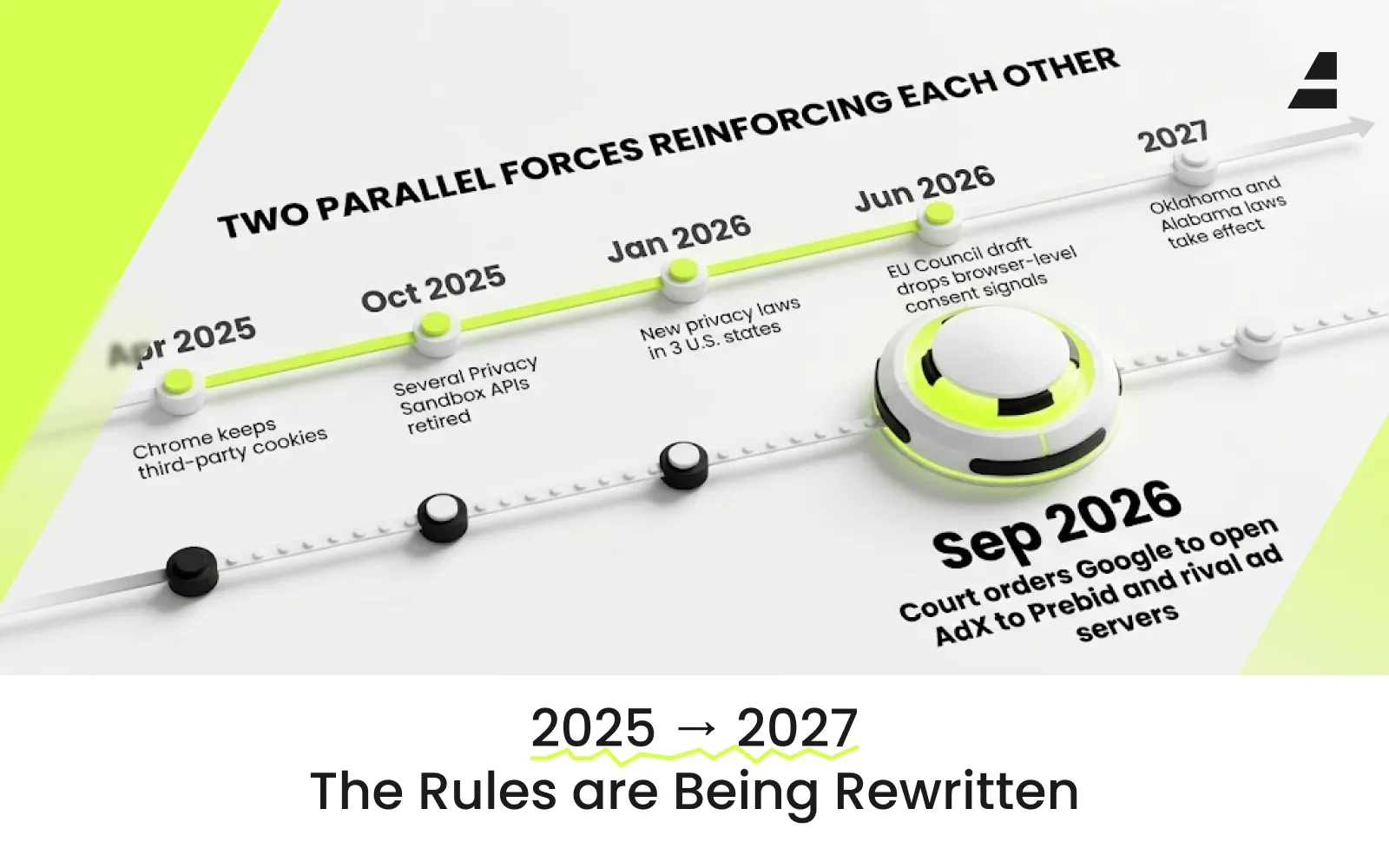
Key privacy and competition milestones, from Chrome keeping third-party cookies in 2025 to new state privacy laws in 2027.
Not sure how these changes affect your campaigns or inventory? Turn insights into outcomes — talk to our experts today.
How Privacy Regulations and Competition Affect Publishers and Advertisers
The same rule changes land differently on each side of the auction. Here is how they play out:
Change | What It Means for Publishers | What It Means for Advertisers |
AdX ordered to open to Prebid and rival ad servers | More demand could compete for each impression | More paths to the same inventory |
Unified Pricing Rules dropped for indirect demand | Floors set per bidder | Floors that can differ by buyer |
Publisher data export and auction data | A clear view of which partners pay and which only fill | Supply paths that are easier to audit |
Consent and opt-out laws | Clean-consent inventory gets easier to price | Fewer usable identifiers in some markets |
Possible EU structural remedy | More change may follow in Europe | Plans need room for another shift |
Publishers stand to gain the most. If they are ready. The ones who grow revenue after a market shift already test floors weekly and read bid density the way traders read an order book. Volume alone has stopped being a strategy, which is why selling more ads is no longer the answer.
Key Drivers Behind the New AdTech Rules
Seven forces are behind the shift, and most of them will outlast this year's headlines:
Universal opt-out signals. At least a dozen U.S. state laws require businesses to honor signals such as Global Privacy Control.
Targeted advertising opt-outs. Oklahoma and Alabama added this right in laws that take effect in 2027.
Consent moving into the GDPR. The Digital Omnibus proposes one-click refusal and limits on how often sites can ask again.
Weak adoption of cookie alternatives. Google cited low adoption when it retired several Privacy Sandbox technologies.
Court-ordered interoperability. The court ordered AdX to work with Prebid and send bids into non-Google ad servers.
Long-term oversight. A court-appointed monitor and technical committee will watch Google's compliance for six years.
Pressure from Brussels. The European Commission fined Google €2.95 billion in 2025 and still leans toward a structural remedy.
Each one narrows what can be collected or hidden. Together, they push the market toward fewer black boxes.
How Brands and Publishers Can Adapt
None of this requires a new playbook from scratch. It does require a few habits that many teams have postponed.
Strategy 1: Treat Consent as Part of Media Quality
An impression served without a valid legal basis is a liability with a CPM attached. Check how partners pass consent strings and honor opt-out signals, market by market, before scaling spend.
Strategy 2: Build Targeting Beyond One Identifier
The campaigns that hold their numbers through regulatory shifts rarely depend on a single ID. They mix contextual intent, device and time signals, and lawful first-party data. And even the best audience data has a ceiling: smarter targeting can't fix bad inventory.
Strategy 3: Prepare Header Bidding for AdX Access
Publishers should review Prebid setups, bidder lists and floor rules now. The plaintiffs want key integrations live within six months, Google wants twelve. Either way, the open-web auction is being re-plumbed.
Strategy 4: Make Every Dollar Auditable
Regulators will keep asking harder questions about data. Advertisers and publishers should be able to answer them from their own dashboards.
How Afront Helps Advertisers and Publishers Adapt to Privacy Regulations
Afront works across CTV, video, display and interstitial formats, reaching 300M+ unique users with 2B+ monthly impressions in 150+ countries. Here is what that looks like under the new rules:
Compliance built in. GDPR and CCPA compliance, brand-safe inventory and ad fraud prevention tools.
Targeting beyond one identifier. Behavioral, contextual, device and timing signals with real-time optimization.
Flexible publisher setup. Integration via Prebid, SDK or direct tags, with open auction, PMP and direct deals.
Yield and reporting you can check. Adaptive floor pricing and real-time revenue and campaign statistics.
Planning your next campaign or monetization strategy around the new rules?
Let's bring your brand to the front. Contact our team today.
Final Thoughts
Privacy rules limit what you can collect. Competition rules limit what you can hide. In 2026, the adtech landscape is getting both at once.
Fee structures nobody explained, auctions nobody documented and data that never left the platform are now on the table. For independent platforms, that is a real opening. A more level auction rewards partners who can show their work.
 Programmatic auction black box opening to reveal bids, floor prices and fees
FAQ
How are privacy regulations affecting programmatic advertising?
They decide whether user data can be used for targeting or measurement in each market. Consent rules, opt-out signals and new U.S. state laws mean every impression needs a valid legal basis.
Did Google have to sell AdX after the ad tech antitrust ruling?
No. In September 2026, Judge Leonie Brinkema rejected a forced sale of AdX and ordered behavioral remedies, including Prebid integration, AdX bids for rival ad servers and a six-year monitor. Implementation depends on the final judgment and the compliance process.
Are third-party cookies still used in Chrome in 2026?
Yes. In April 2025, Google confirmed it would keep its current approach to third-party cookies, and in October 2025 it retired several Privacy Sandbox technologies. Privacy regulations still limit how cookie data can be used, depending on consent and local law.
What does the Prebid remedy mean for publishers in header bidding?
Under the court's remedies, Google must build an adapter so Prebid setups can request and receive AdX bids. Once it is live, publishers could get more demand competing in header bidding and more control over how ad requests are routed
