

For years, publisher monetization followed a fairly comfortable equation. More ad placements meant more impressions. More impressions meant more opportunities to sell. More opportunities should mean more revenue.
The math looks reasonable. The problem is that readers don't experience websites as spreadsheets.
Add another banner. Insert another video. Refresh another placement. Push another auction into the page. Eventually, the additional inventory starts competing with everything else on the screen — including the content people actually came to see.
And increasingly, publishers are questioning whether maximizing the number of ads is really the same thing as maximizing the value of their inventory.
Recent industry moves suggest it isn't.
The Ad-Load Experiment Is Getting Expensive
There is a simple reason publishers keep adding inventory: sometimes it works.
A recent large-scale study of sponsored search found that increasing ad load could raise revenue substantially. But there was a catch. More sponsored slots also reduced total search conversions and daily engagement. The researchers found that the effect varied considerably depending on the query and advertiser mix.
That last point matters. The answer isn't universally "fewer ads." It's the right ad load for the right environment.
Publishers operate a system with competing objectives. Revenue per page matters. So does viewability. Session depth matters. So do page speed, advertiser performance and whether the reader comes back tomorrow.
Optimizing only one of those variables is easy. Optimizing the whole equation is where modern publisher monetization gets interesting.
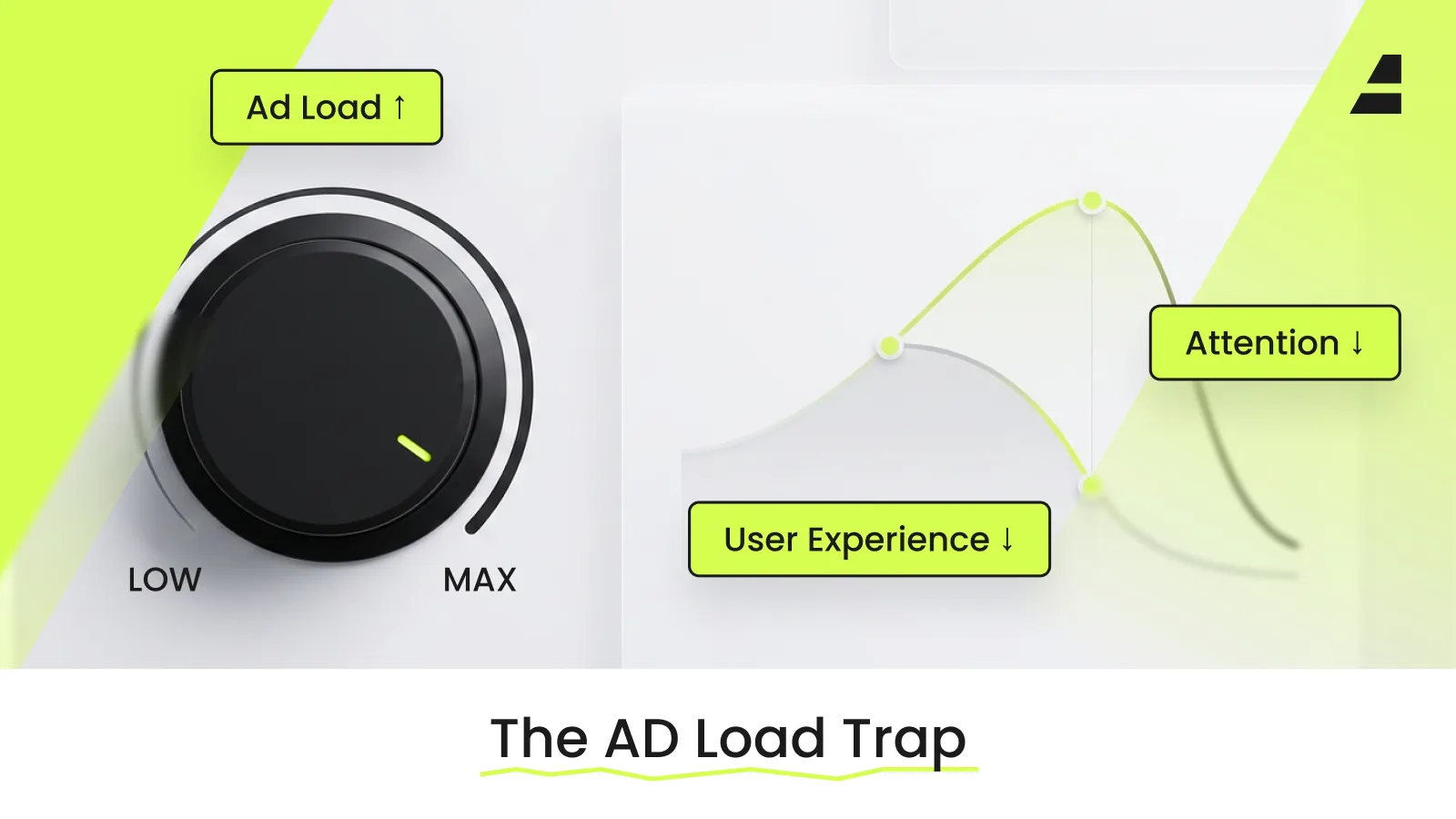
Publisher ad load and user experience: how increasing ad volume can reduce audience attention and weaken the user experience.
Some Publishers Are Already Cutting Back
Mail Metro Media offers a particularly useful example.
In 2026, the publisher began shifting its commercial strategy toward PMPs, first-party data and a lighter advertising experience. It is reducing the number of ads per page from 10 to three and cutting ad loads by 80% for subscribers. At the same time, the company is putting greater emphasis on private marketplaces and outcomes rather than simply maximizing open-market volume.
That's quite a statement from a publisher operating at a serious scale. The strategy isn't "sell less and hope." It's to make the remaining opportunities more valuable.
Separate research from Mail Metro Media and Lumen Research gives the argument more weight. In testing lower-ad-load premium environments, the percentage of ads viewed increased from 53% to 78%. The research compared premium layouts with up to five ads on desktop and three on mobile against environments containing as many as 15.
Fewer opportunities can create stronger opportunities. That distinction matters to advertisers too.
An Impression Isn't Valuable Because It Exists
Programmatic advertising made it possible to transact enormous volumes of inventory efficiently.
But volume can hide weak economics. An ad placement that technically exists but receives little attention isn't equivalent to a highly viewable placement inside a strong content experience. Nor should the two necessarily command the same advertiser demand.
Publishers therefore need to look beyond fill rate. Bid density can reveal how much competition exists for an impression. Dynamic floor pricing can respond to changing demand. Session-level yield can show whether monetization decisions are helping or hurting the total value generated from a user visit.
This is where Afront's publisher strategy is deliberately focused. Its platform combines real-time analytics with dynamic pricing tools, including adaptive floor pricing, bid-density analysis and session-level yield metrics. Its yield engine uses real-time data, historical patterns and predictive modeling to adjust floors and auction pressure rather than treating every impression identically.
That's a very different question from "Where can we put another ad?" It's asking: What is this impression actually worth?
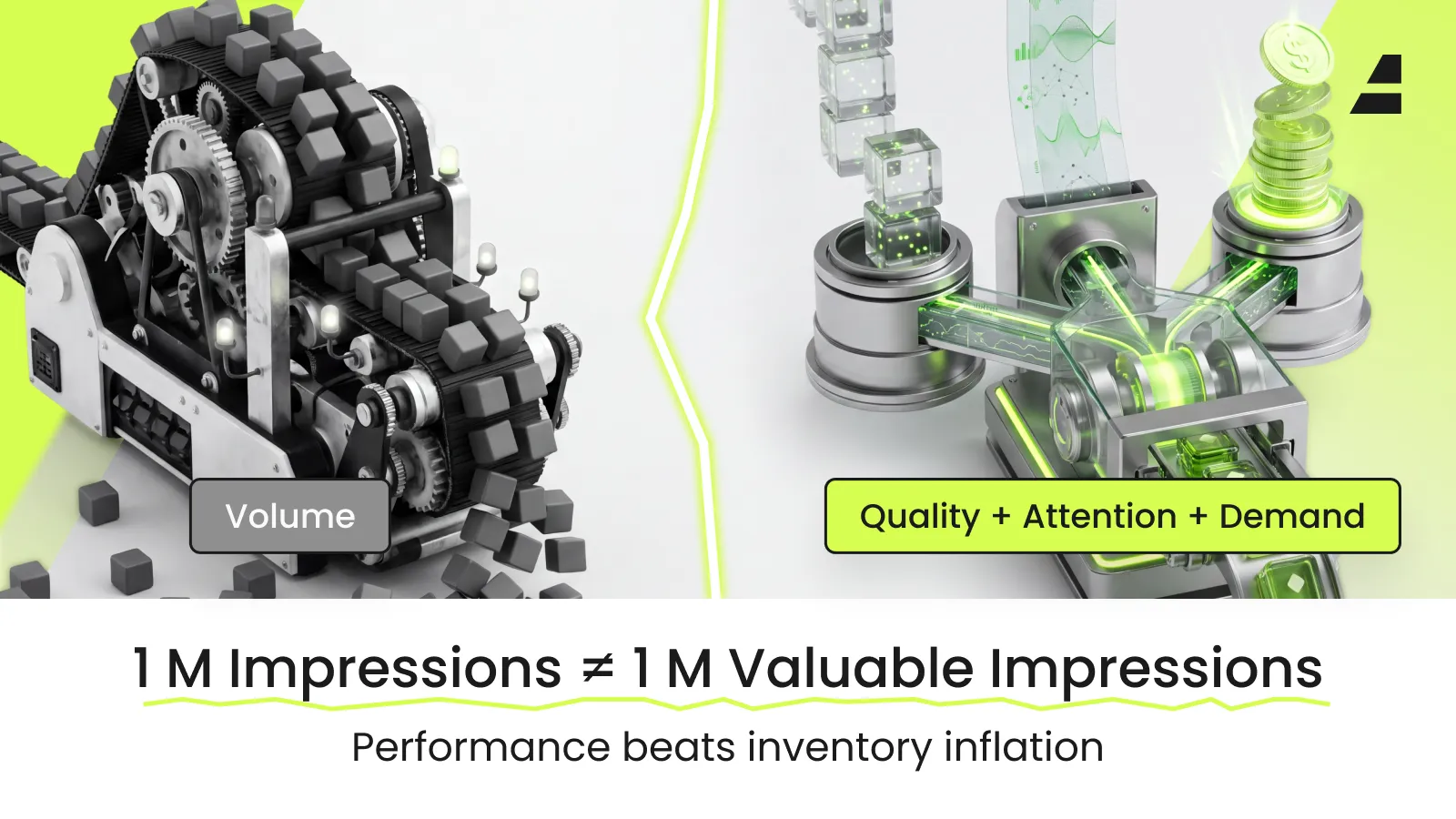
Publisher monetization and impression quality: why valuable impressions, audience attention and premium demand matter more than simply increasing ad inventory.
Better Demand Beats More Demand
There is another misconception worth challenging. Connecting more demand partners does not automatically create better monetization. The quality and structure of that demand matter.
Publishers increasingly have multiple routes to market: open auctions, private marketplaces, programmatic guaranteed deals and direct relationships. Each can play a role. But simply adding more pipes can also add complexity without necessarily adding meaningful auction pressure.
Mail Metro Media's current strategy is again revealing. Its push toward PMPs reflects growing interest in cleaner, more accountable paths between buyers and publishers. According to Digiday, first-party commerce and audience signals are being used to demonstrate not just audience reach, but purchase intent and outcomes.
Afront follows a similar quality-first principle by connecting publisher inventory with curated demand from DSPs, verified global brands and programmatic buyers across open auctions, PMPs and programmatic guaranteed deals.
The aim isn't to make every buyer bid. It's to create stronger competition from buyers worth having.
Viewability Changes the Revenue Equation
One underperforming ad can affect more than its own revenue.
An older but instructive example comes from The Washington Post. The publisher removed a bottom-of-page unit that generated meaningful revenue but suffered from low viewability and weak performance. The expected revenue loss didn't materialize as feared. Improving the site's overall viewability helped CPMs elsewhere rise.
Bloomberg Media later made an even more aggressive move by eliminating open-market third-party programmatic display advertising.
The early results were mixed financially, but revealing operationally. Adweek reported a 40% reduction in page-load time, 15% reduction in average ad-load time and 20% increase in viewability. CPMs rose roughly 20%.
Neither example proves every publisher should start deleting ad units tomorrow. They prove something more useful.
Inventory has externalities.
A weak placement can affect page performance, user experience and how buyers value the rest of the inventory.
The value of an ad slot cannot always be measured in isolation.
Monetization Should Work at the Session Level
This changes how publishers should think about revenue. Imagine Publisher A serves ten ads during a visit.
Publisher B serves six. Looking only at impression volume, Publisher A wins.
But what if Publisher B's placements have stronger viewability, higher bid competition, better CPMs and a cleaner experience that keeps the visitor reading another article?
Suddenly, counting ads tells us very little. Revenue per session becomes more meaningful. So does revenue per user. Engagement after ad exposure matters. Page speed matters. Repeat visits matter. And optimization becomes continuous rather than something performed once when the ad stack is configured.
Afront supports that kind of approach with real-time optimization around floor pricing, refresh logic and fill prioritization, alongside live reporting and revenue diagnostics. Publishers can integrate through Prebid, SDK or direct tag-based connections and choose between open auctions, PMPs and direct strategies.
The objective is not maximum inventory. It's maximum productive inventory.
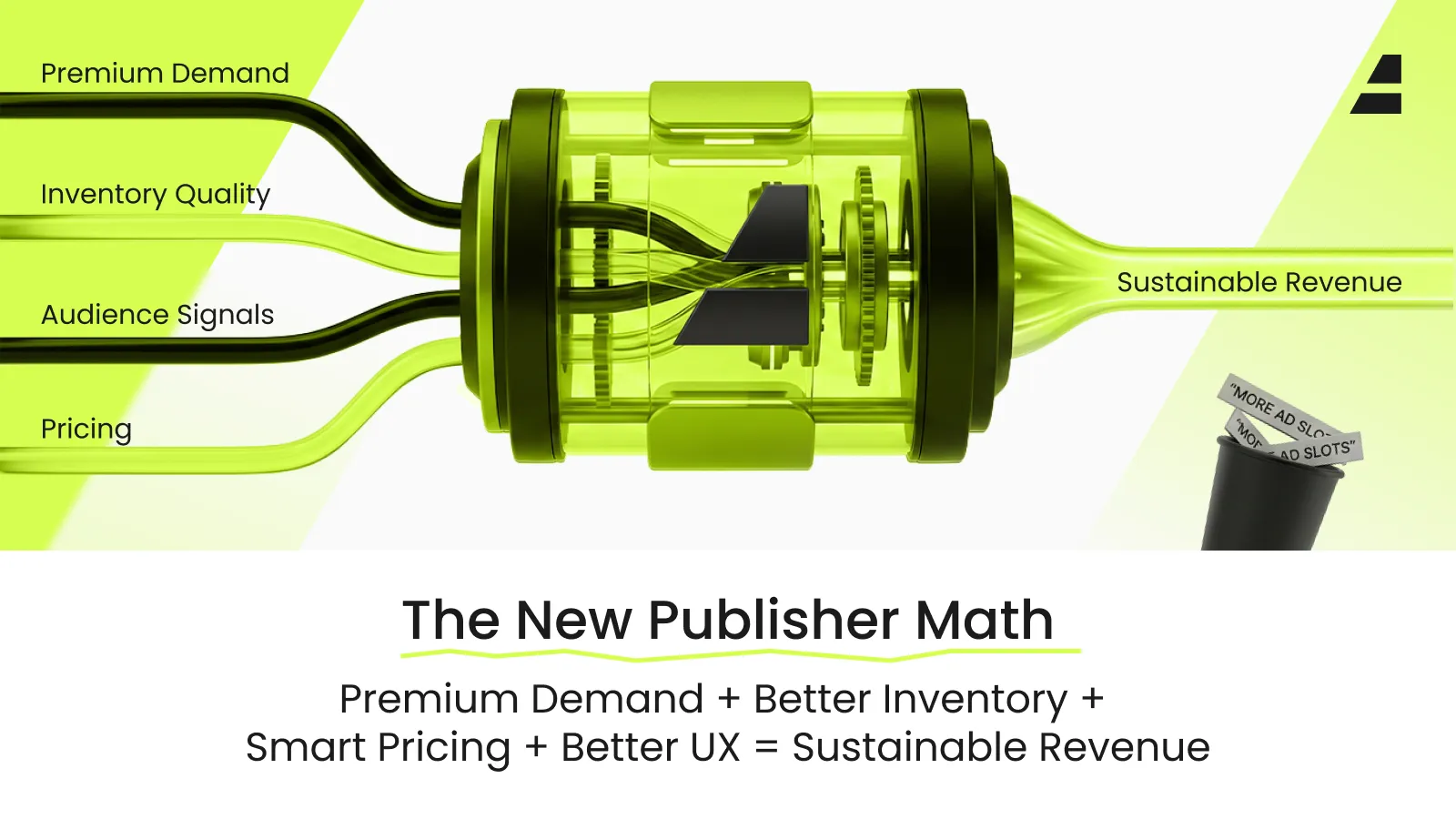
Smart publisher monetization with Afront: combining premium demand, inventory quality, audience signals and smart pricing to drive sustainable programmatic revenue.
CTV Makes the Trade-Off Even More Obvious
The same logic becomes harder to ignore on connected TV.
Wurl's CTV Trends Report found streaming publishers converging around an ad load of roughly nine minutes per hour, considerably below the approximately 15 minutes associated with traditional linear television. Wurl also noted that publishers had not meaningfully increased CTV ad loads even as demand increased.
That makes sense. CTV viewers didn't leave traditional television so streaming services could rebuild exactly the same commercial experience.
For publishers, the opportunity is to make premium video inventory worth more — not simply manufacture more interruptions.
Afront supports publishers across high-impact environments including CTV, video and display, connecting premium inventory with advertiser demand through real-time bidding and programmatic solutions.
As CTV grows, restraint may become part of the monetization strategy.
The Better Question Is Revenue per Opportunity
Selling more ads isn't disappearing as a business model. But treating inventory volume as the primary growth lever is becoming increasingly crude.
Publishers now have much better tools. They can analyze bid density. Adjust floors dynamically. Compare demand paths. Improve viewability. Prioritize higher-quality buyers. Control refresh logic. Measure revenue at the session level. Use predictive models to understand where the next dollar of yield is actually hiding.
Afront's publisher proposition is built around that idea: premium content should generate premium monetization through stronger demand, yield intelligence and transparent control — not simply through more impressions.
And the scale behind that infrastructure is substantial. Afront reaches more than 300 million unique users, delivers 2B+ monthly ad impressions, works across 30,000+ publishers and 150+ countries, and reports a viewability rate above 95%.
The smartest publisher monetization question in 2026 isn't:
"How many more ads can we sell?"
It's:
"How much more value can we create from the inventory we already have?"
From Better Inventory to Better Omnichannel Performance
The same shift from volume to value is happening on the advertiser side. Mobile advertising, for example, is increasingly useful not as an isolated source of installs, but as one part of a wider customer journey across devices, formats and environments.
We explored that idea in our previous article, “Beyond the Install: Why Mobile Advertising Is Becoming an Omnichannel Performance Engine.” Read the full article.
Make Your Inventory Work Smarter
More impressions are easy to count. Better yield takes more work.
Afront helps publishers unlock more value from their inventory through premium demand, adaptive pricing, real-time optimization and transparent performance insights — across CTV, video, display and other programmatic environments. Its publisher offering is designed around improving monetization without compromising the user experience.
