
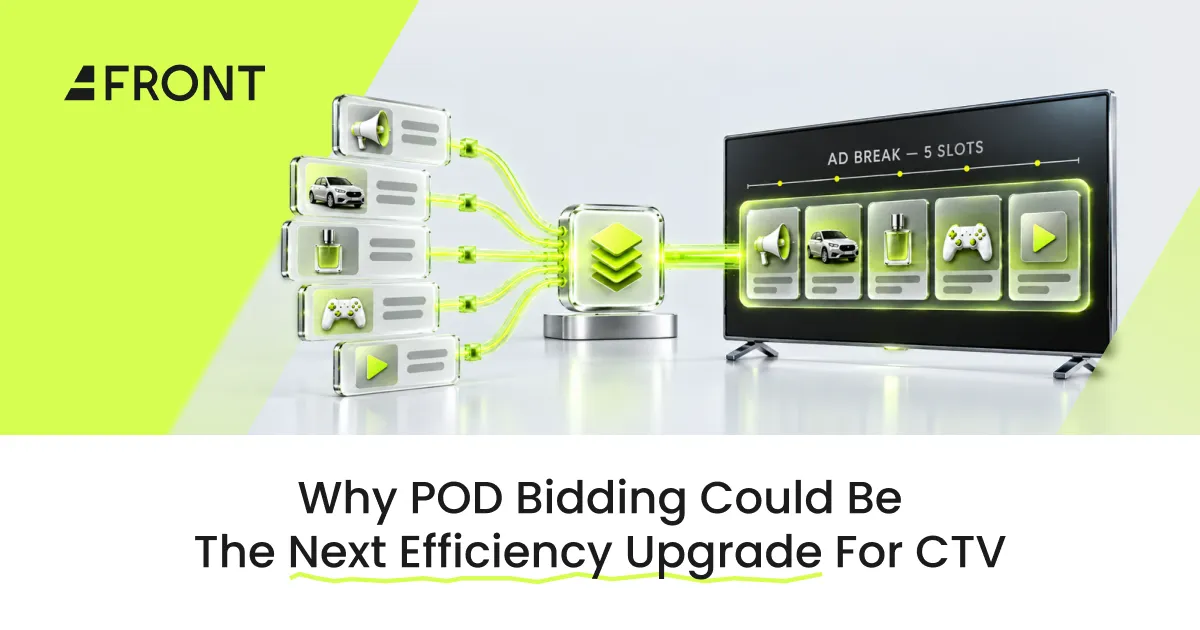
Connected TV has given programmatic advertising one of its most valuable environments: premium video, large screens, engaged audiences, and the targeting and measurement capabilities of digital media.
But behind the TV screen, buying CTV inventory can still be surprisingly inefficient.
One reason is simple. A TV commercial break is not one advertising opportunity. It is usually a group of ads played together — an ad pod.
Traditional programmatic infrastructure was largely built around a simpler model: one impression opportunity, one bid request. Apply that logic to a CTV break containing several ad slots and the amount of auction traffic can multiply quickly.
Pod bidding offers another way.
Instead of treating every position inside the commercial break as an isolated opportunity, it gives buyers more information about the entire pod and lets them respond accordingly.
It sounds like a technical adjustment. In practice, it could remove a meaningful amount of unnecessary work from CTV auctions.
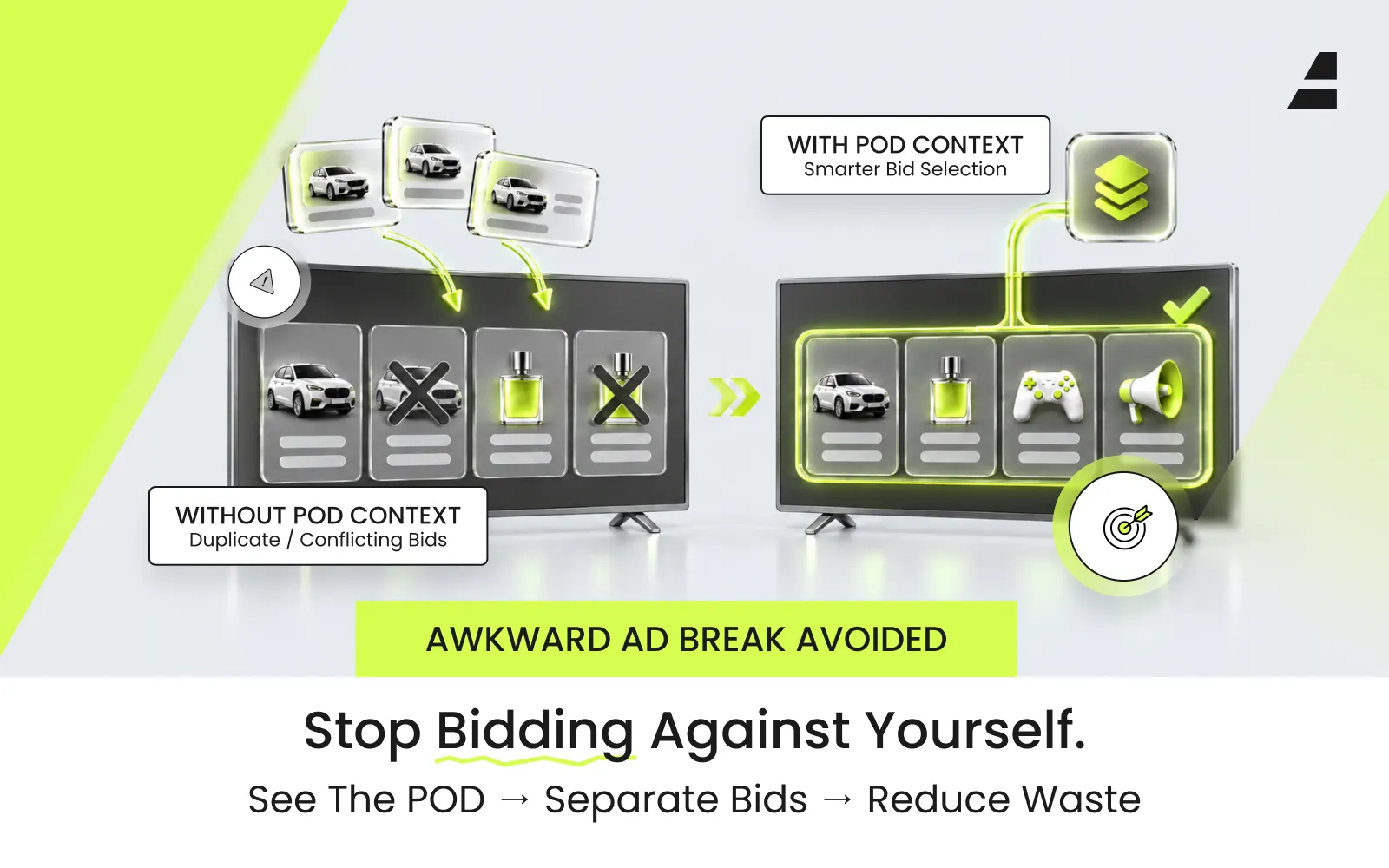
Comparison of CTV ad pods with and without pod context, showing how programmatic pod bidding helps prevent duplicate and conflicting ads through smarter bid selection.
What Is Pod Bidding?
An ad pod is essentially the digital version of a traditional TV commercial break: several ads appearing consecutively before the content continues.
Pod bidding was introduced into OpenRTB 2.6 specifically to improve how video and audio ad pods are represented programmatically. The standard allows sellers to communicate information such as the total pod duration, maximum number of ads, and the relationship between opportunities within the same pod.
The important difference is context.
Without effective pod signaling, a DSP may receive separate requests for individual slots without having a clear enough picture that those opportunities belong to the same commercial break.
With pod bidding, the platform can communicate the pod as a connected opportunity.
That changes what the buyer knows before it bids.
Why CTV Has a QPS Problem
Queries per second, or QPS, might not be the most exciting metric in advertising. But at scale, it matters.
Imagine a CTV commercial break containing five available slots.
If each slot produces a separate bid request, a DSP may have to process five requests for what is effectively one commercial break.
Now multiply that across millions of viewing sessions.
The infrastructure load becomes substantial.
Ad Tech Explained illustrates how a five-slot example could move from five individual requests to one pod-based request. That would represent a 5x reduction in QPS for that specific example. The exact improvement depends on implementation and pod structure, so it should not be treated as a universal benchmark.
Still, the principle is important.
Fewer unnecessary requests mean less infrastructure work for the same underlying advertising opportunity.
That matters during ordinary streaming. It can matter even more when audiences spike around live programming and other high-demand moments.
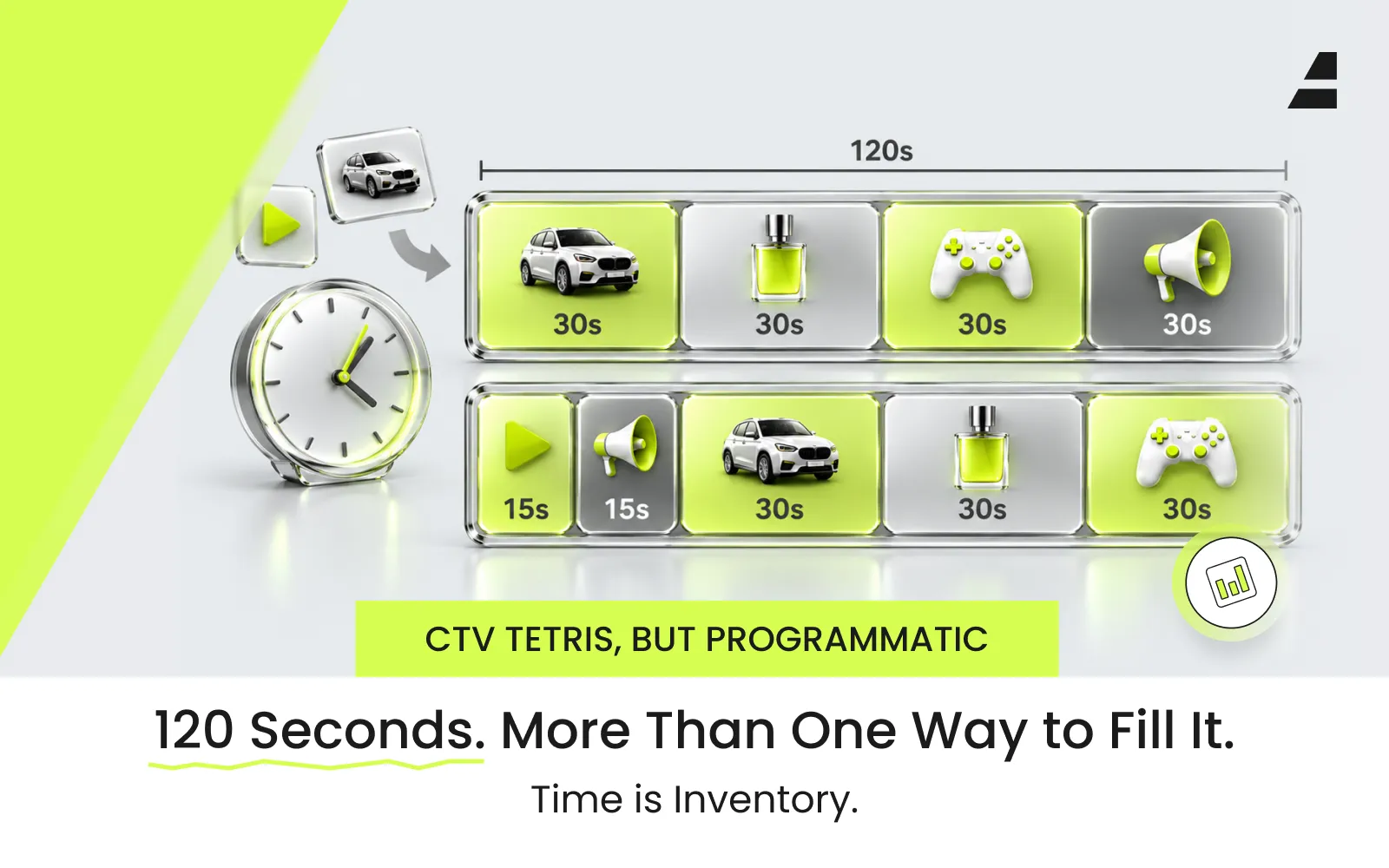
Illustration of dynamic CTV ad pod optimization showing how a 120-second ad break can accommodate different combinations of 15-second and 30-second ads.
Pod Bidding Helps Buyers Stop Competing With Themselves
There is another inefficiency hidden inside traditional slot-by-slot bidding.
Suppose a DSP sees several requests without knowing they belong to the same pod. It could return multiple creatives from the same advertiser or competing advertisers from the same category.
The publisher may have rules preventing those ads from appearing together.
Some bids then have to be discarded when the final pod is assembled.
The DSP has spent resources evaluating and bidding on opportunities that never had a realistic chance of appearing together.
Pod bidding gives the buyer more context.
When a DSP knows it is responding to opportunities within the same pod, it can deduplicate creatives and apply competitive separation before returning its bids. That can reduce conflicting responses and improve the chances that submitted bids are actually usable.
For publishers, buyers, and viewers, that is a much cleaner system.
A More TV-Native Way to Buy Streaming Inventory
CTV is digital advertising, but the viewing experience still has a lot in common with television.
People expect commercial breaks to feel coherent. Seeing the same ad repeatedly inside one break is noticeable. So is an awkward break with poorly assembled advertising.
Programmatic systems therefore need to understand more than individual impressions.
They need to understand the break.
That was one of the reasons pod bidding became an important part of OpenRTB 2.6. IAB Tech Lab describes the feature as a way for sellers to communicate structured or more flexible pod opportunities, while giving buyers greater flexibility in how they respond.
This is a subtle but meaningful change.
Programmatic CTV becomes less about forcing television inventory into impression-by-impression mechanics and more about building auction mechanics that reflect how streaming advertising is actually consumed.
Dynamic Pods Add Another Layer of Flexibility
Pod bidding also supports more flexible ways of constructing an ad break.
A structured pod can define specific slots and durations in advance.
A dynamic pod can instead define the total duration of the break and constraints such as the maximum number of ads. Buyers can then respond with an appropriate combination of eligible creatives. OpenRTB 2.6 formally defines both models.
Imagine a 120-second commercial break.
Rather than treating it purely as a predetermined collection of fixed slots, a dynamic approach can allow more flexibility in how eligible 15- or 30-second creatives are combined within the rules of the pod.
That gives publishers another way to represent their inventory and gives buyers more information for making bidding decisions.
The auction becomes aware of something television has always understood: time itself is part of the inventory.
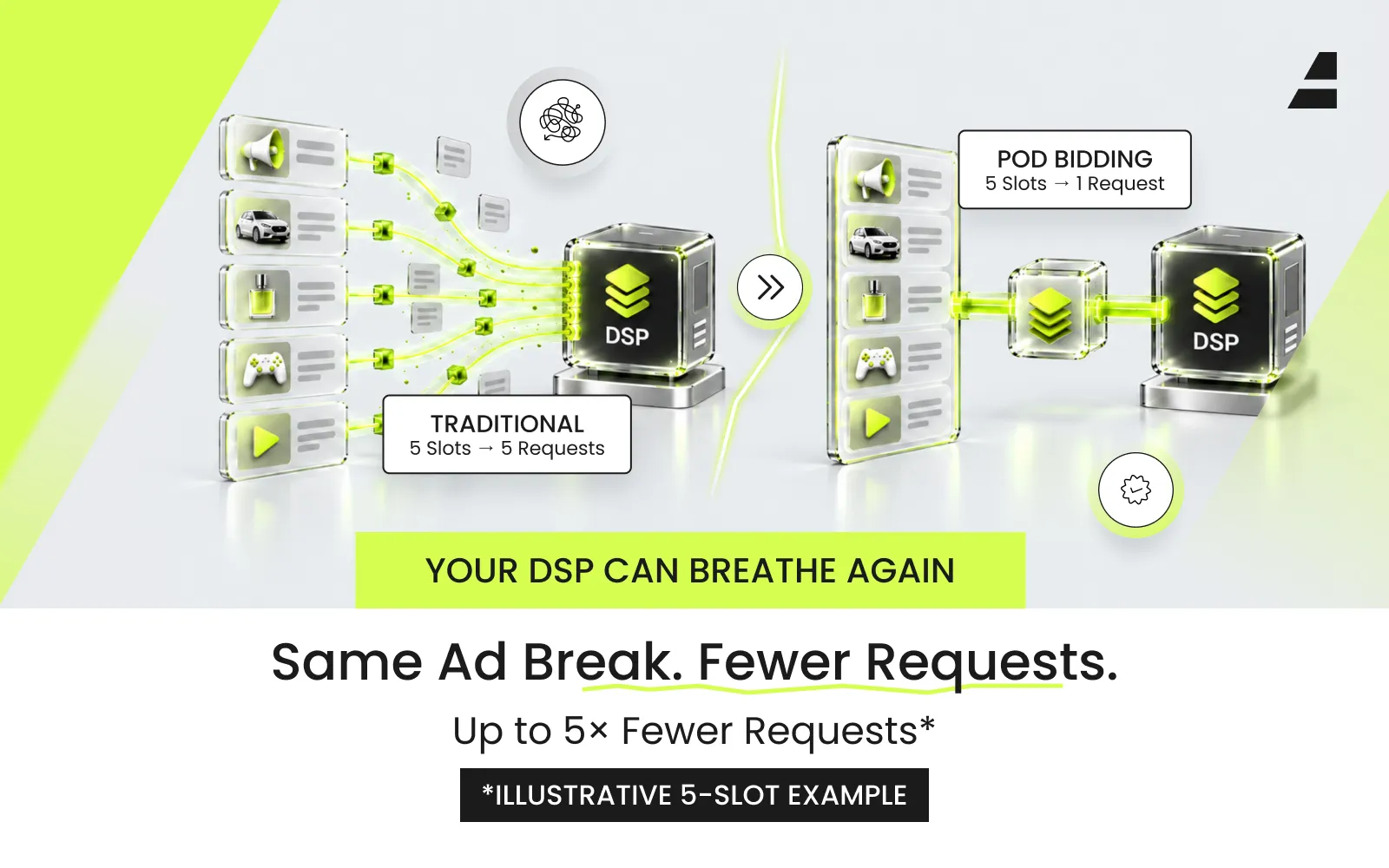
Comparison of traditional CTV bidding with five separate requests versus pod bidding with one request containing five ad slots, illustrating potential reductions in DSP request volume.
Efficiency Matters More as CTV Scales
Pod bidding is not a magic switch for better CTV monetization.
Implementation matters. DSP and SSP support matters. Publisher rules matter. And, as Ad Tech Explained notes, support is not yet universal across major DSPs.
That caveat is important.
But the underlying problem is not going away.
As more premium streaming inventory is traded programmatically, unnecessary auction traffic becomes more expensive. Poor coordination between individual slots becomes harder to ignore. Live environments put additional pressure on infrastructure.
Small inefficiencies become big ones when repeated millions of times.
Pod bidding tackles that problem at the auction-design level.
Instead of asking infrastructure to process more and more isolated requests, it gives platforms a richer representation of the actual opportunity.
That is the kind of improvement CTV needs as programmatic buying matures.
What It Means for Publishers
For publishers, better pod signaling can support smarter monetization without treating every slot as a disconnected impression.
More information about the commercial break can help demand partners make better-informed responses. Fewer conflicting bids can reduce waste during pod construction. More flexible pod structures can also create additional options for how airtime is packaged and sold.
This aligns with a broader principle at Afront: maximizing publisher revenue is not simply about generating more requests.
It is about making inventory work smarter.
Afront connects publishers with premium programmatic demand across high-impact formats including CTV and video, while using real-time analytics, auction intelligence, and optimization to help unlock more value from inventory. Our publisher proposition emphasizes premium demand, transparent reporting, dynamic pricing, and smarter auctioning rather than volume for volume’s sake.
CTV is a good example of why that distinction matters.
Better Infrastructure Can Create Better Advertising
Most viewers will never know what pod bidding is.
That is probably a good thing.
The best infrastructure improvements are often invisible to the person watching the screen.
But advertisers and publishers feel the effects when auctions become more efficient, bids are better informed, commercial breaks are assembled more intelligently, and technology can handle demand without doing unnecessary work.
CTV has already become an important part of the omnichannel advertising mix. The next stage is not simply adding more inventory.
It is making the infrastructure behind that inventory better.
Pod bidding is one piece of that work.
And sometimes the most meaningful upgrade in AdTech is not another targeting signal or another dashboard.
It is simply finding a smarter way to run the auction.
From Retail Media to CTV: AdTech Infrastructure Is Expanding
The same infrastructure question is appearing elsewhere in digital advertising.
Retailers are building media networks around first-party commerce data, inventory, targeting, and measurement — increasingly taking on functions traditionally associated with AdTech companies.
Learn that shift in our previous article, “When Advertising Grows Faster Than Ecommerce, Is Every Retailer Becoming an AdTech Company?”
Whether we are talking about retail media or CTV, the direction is similar: more valuable advertising environments require infrastructure that can handle complexity without sacrificing efficiency, transparency, or performance.
Want to make your CTV and programmatic strategy work smarter? Afront combines premium inventory, advanced targeting, real-time optimization, and transparent reporting to help advertisers and publishers turn programmatic opportunities into measurable results.
