
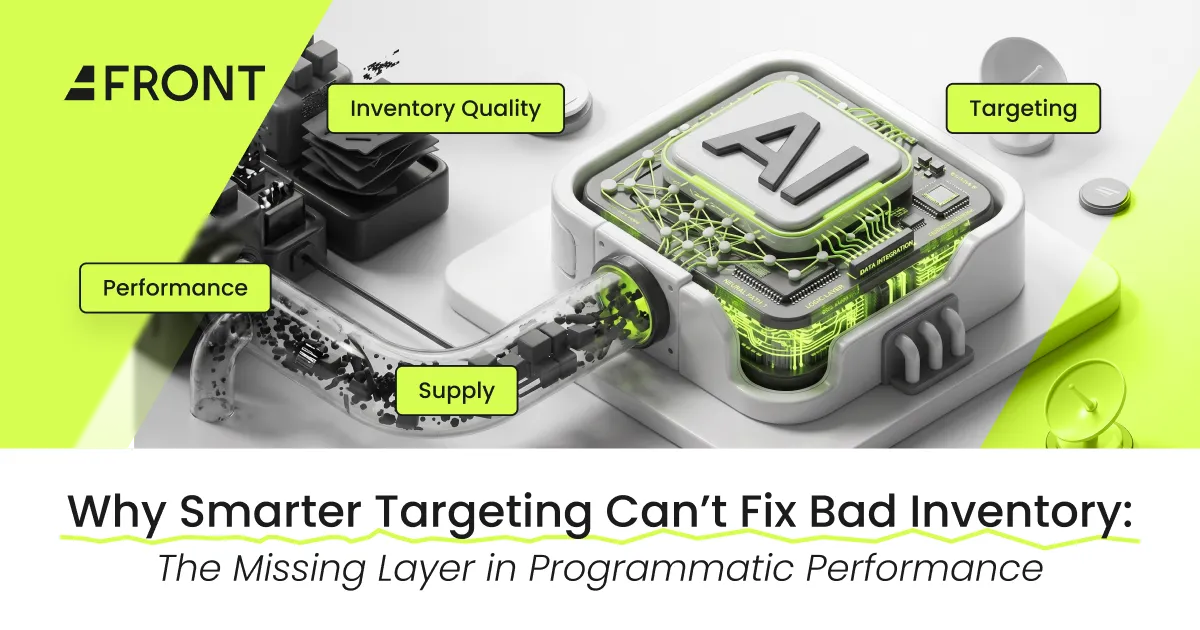
Ask almost any marketer how to improve campaign performance and you'll hear the same answers. Better targeting. Better creatives. Better optimisation.
They're all important.
But there's another factor that rarely gets the same attention, even though it influences every impression you buy.
Inventory.
It's one of those topics that doesn't sound particularly exciting. Nobody builds a presentation around inventory quality. Yet experienced media buyers know that where an ad appears often matters just as much as who sees it.
You can have exceptional audience data, sophisticated machine learning models and perfectly timed bidding strategies. If your campaign ends up in poor environments, the results usually follow the same direction.
No algorithm can rescue a bad placement.
Targeting Has Never Been Smarter
Programmatic advertising has made enormous progress over the past decade.
Audience modelling has become remarkably sophisticated. Advertisers can combine behavioural signals, contextual insights, purchase intent, device usage and first-party data to build audiences with impressive precision.
AI has pushed that even further.
Modern optimisation engines adjust bids in milliseconds, identify valuable users before they convert and constantly redistribute budgets towards stronger-performing opportunities.
Compared with where the industry stood just a few years ago, media buying has become significantly more intelligent.
That's exactly why inventory deserves more attention.
When targeting capabilities become similar across platforms, the quality of supply becomes a bigger competitive advantage.
Two advertisers can target almost identical audiences.
One reaches users through trusted publishers with highly viewable placements.
The other buys cheaper impressions scattered across low-quality websites with weak engagement and questionable traffic.
Both campaigns technically reached the same audience.
Only one is likely to build meaningful results.
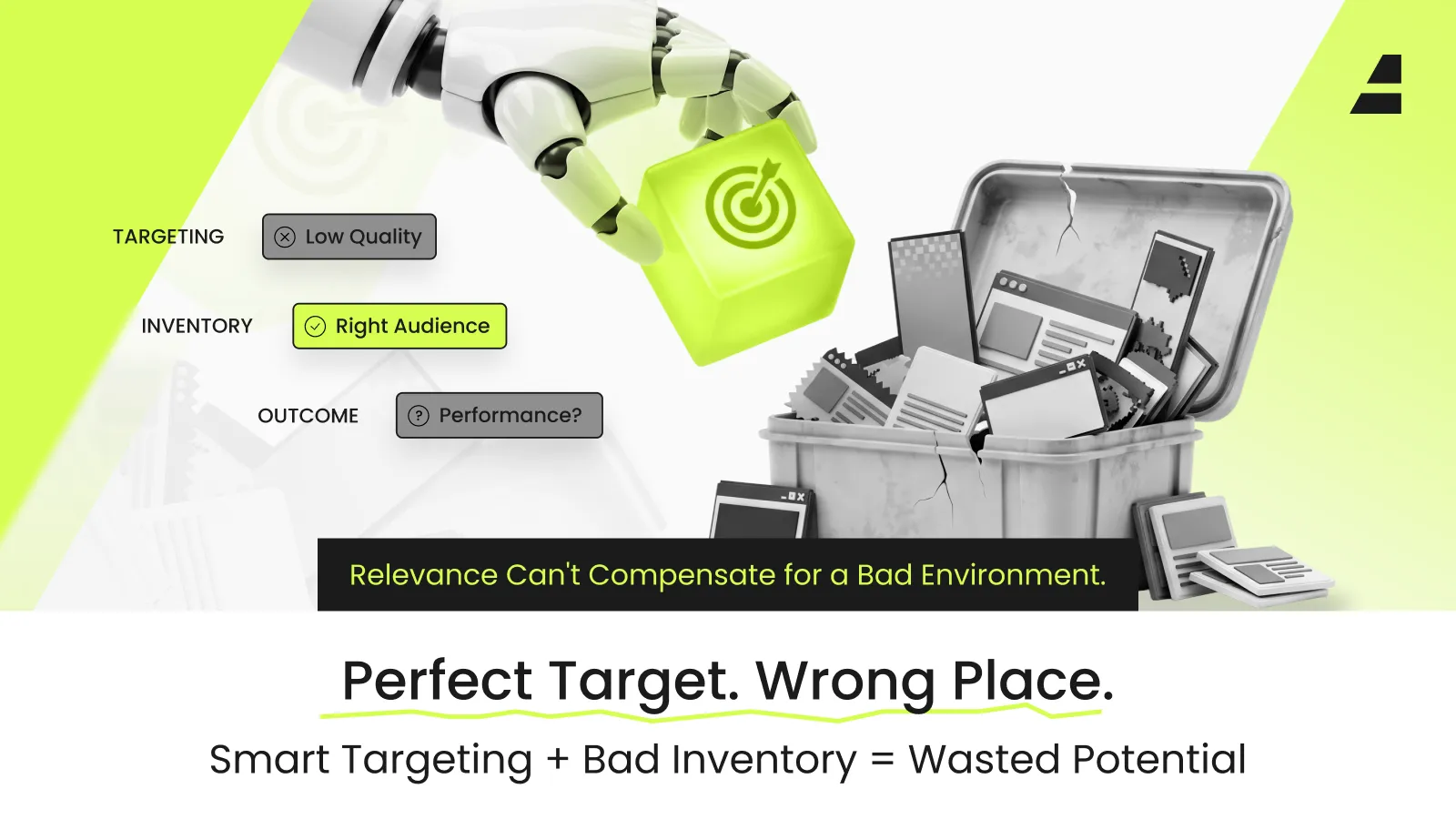
An AI-powered advertising illustration showing perfect audience targeting failing because ads are served within poor-quality inventory. The image explains why campaign success depends on both intelligent targeting and premium inventory rather than audience data alone. Ideal for content about mobile advertising, programmatic performance, AI optimisation, inventory quality and digital media buying.
Cheap Inventory Usually Comes at a Price
Every advertiser enjoys lowering acquisition costs.
Nobody enjoys paying for wasted impressions.
The problem is that those two goals don't always align.
Lower CPMs often look attractive during campaign planning, especially when budgets are under pressure. But experienced buyers know the cheapest inventory frequently becomes the most expensive once performance is measured properly.
Poor viewability reduces attention.
Weak content environments reduce trust.
Fraudulent traffic inflates delivery without creating genuine engagement.
The campaign appears efficient until someone looks beyond the headline metrics.
Then the real picture emerges.
This is why sophisticated advertisers spend less time asking, "How cheap can we buy media?" and more time asking, "Which environments consistently produce business results?"
Those aren't the same question.
Premium Publishers Still Matter
The industry's obsession with automation sometimes creates the impression that every impression is interchangeable.
It isn't.
Context still influences how people respond to advertising.
Someone watching premium streaming content, reading trusted journalism or engaging with respected publishers behaves differently from someone rapidly clicking through low-quality pages overloaded with ads.
Advertisers notice it in conversion rates.
Publishers see it in buyer demand.
Consumers experience it through less intrusive advertising.
Quality environments continue to outperform because they create something algorithms cannot manufacture.
Attention.
No amount of optimisation can create genuine engagement if users have already learned to ignore the content surrounding an advertisement.
Premium inventory doesn't simply improve brand perception.
It improves campaign efficiency.
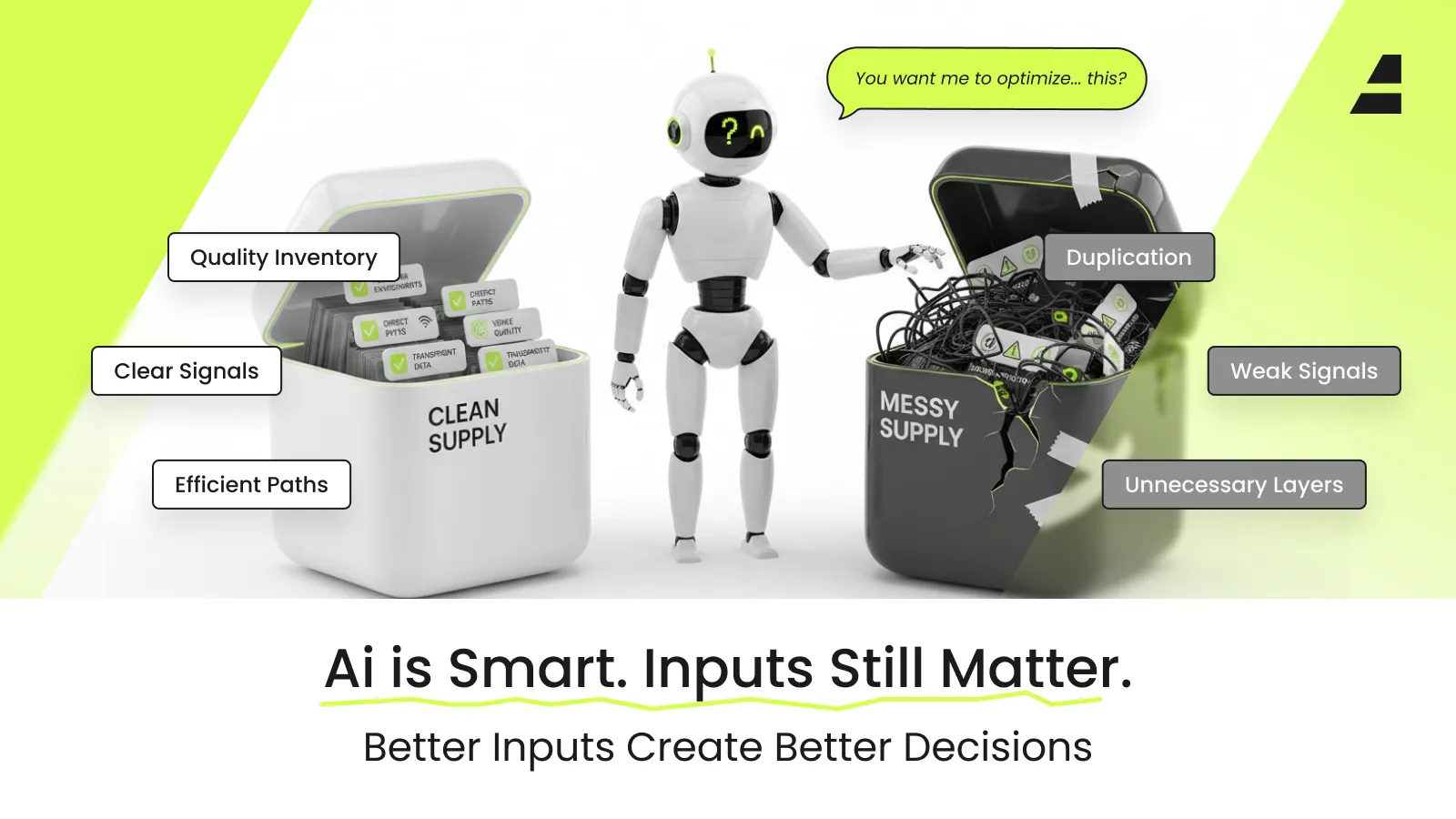
A conceptual illustration comparing clean and poor-quality programmatic supply paths. AI evaluates transparent, high-quality inventory alongside duplicated, low-signal inventory to demonstrate how better data inputs produce stronger optimisation decisions. The visual represents AI decisioning, supply quality, programmatic advertising, omnichannel optimisation and advertising performance.

An illustration showing performance marketing as a balance between smart audience targeting, quality inventory, efficient supply paths and real-time optimisation. Rather than relying on targeting alone, successful programmatic campaigns combine multiple optimisation layers to maximise advertising performance, improve campaign efficiency and deliver sustainable business outcomes across omnichannel media buying.
Why Transparency Has Become Part of Performance
Performance marketers have become much more demanding over the past few years.
They don't just want campaigns to perform.
They want to understand why they perform.
If a DSP suddenly shifts budget between publishers, advertisers expect to know what changed. If one inventory source consistently delivers stronger conversion rates, they want visibility into the data behind those decisions.
That expectation isn't slowing down.
It's becoming standard.
The platforms that continue treating reporting as an afterthought will struggle to build long-term trust.
At Afront, transparency isn't positioned as an extra feature sitting alongside campaign optimisation. It's built into how campaigns are managed from day one. Advertisers have access to real-time reporting, clear performance metrics and full visibility into where budgets are spent, while publishers benefit from quality demand and measurable monetisation strategies.
Good reporting doesn't just explain performance.
It helps create better performance.Ask almost any marketer how to improve campaign performance and you'll hear the same answers. Better targeting. Better creatives. Better optimisation.
They're all important.
But there's another factor that rarely gets the same attention, even though it influences every impression you buy.
Inventory.
It's one of those topics that doesn't sound particularly exciting. Nobody builds a presentation around inventory quality. Yet experienced media buyers know that where an ad appears often matters just as much as who sees it.
You can have exceptional audience data, sophisticated machine learning models and perfectly timed bidding strategies. If your campaign ends up in poor environments, the results usually follow the same direction.
No algorithm can rescue a bad placement.
Targeting Has Never Been Smarter
Programmatic advertising has made enormous progress over the past decade.
Audience modelling has become remarkably sophisticated. Advertisers can combine behavioural signals, contextual insights, purchase intent, device usage and first-party data to build audiences with impressive precision.
AI has pushed that even further.
Modern optimisation engines adjust bids in milliseconds, identify valuable users before they convert and constantly redistribute budgets towards stronger-performing opportunities.
Compared with where the industry stood just a few years ago, media buying has become significantly more intelligent.
That's exactly why inventory deserves more attention.
When targeting capabilities become similar across platforms, the quality of supply becomes a bigger competitive advantage.
Two advertisers can target almost identical audiences.
One reaches users through trusted publishers with highly viewable placements.
The other buys cheaper impressions scattered across low-quality websites with weak engagement and questionable traffic.
Both campaigns technically reached the same audience.
Only one is likely to build meaningful results.
Cheap Inventory Usually Comes at a Price
Every advertiser enjoys lowering acquisition costs.
Nobody enjoys paying for wasted impressions.
The problem is that those two goals don't always align.
Lower CPMs often look attractive during campaign planning, especially when budgets are under pressure. But experienced buyers know the cheapest inventory frequently becomes the most expensive once performance is measured properly.
Poor viewability reduces attention.
Weak content environments reduce trust.
Fraudulent traffic inflates delivery without creating genuine engagement.
The campaign appears efficient until someone looks beyond the headline metrics.
Then the real picture emerges.
This is why sophisticated advertisers spend less time asking, "How cheap can we buy media?" and more time asking, "Which environments consistently produce business results?"
Those aren't the same question.
Premium Publishers Still Matter
The industry's obsession with automation sometimes creates the impression that every impression is interchangeable.
It isn't.
Context still influences how people respond to advertising.
Someone watching premium streaming content, reading trusted journalism or engaging with respected publishers behaves differently from someone rapidly clicking through low-quality pages overloaded with ads.
Advertisers notice it in conversion rates.
Publishers see it in buyer demand.
Consumers experience it through less intrusive advertising.
Quality environments continue to outperform because they create something algorithms cannot manufacture.
Attention.
No amount of optimisation can create genuine engagement if users have already learned to ignore the content surrounding an advertisement.
Premium inventory doesn't simply improve brand perception.
It improves campaign efficiency.
Good Supply Creates Better Data
Here's something that often gets overlooked.
Inventory quality affects optimisation itself.
Machine learning depends on signals.
Every click, view, conversion and interaction teaches optimisation models what success looks like.
If those signals come from unreliable inventory, AI learns from unreliable information.
That's a dangerous feedback loop.
The system keeps optimising towards patterns that don't necessarily represent real customers.
High-quality supply creates cleaner data.
Cleaner data produces better optimisation.
Better optimisation improves campaign performance.
It's a cycle that works in the opposite direction too.
Poor inventory contaminates measurement long before marketers realise what's happening.
The Conversation Is Finally Changing
A few years ago, advertisers mostly talked about audience targeting.
Today, conversations increasingly include supply paths, publisher quality, transparency and inventory curation.
That's a healthy shift.
The industry is recognising that performance doesn't start at the bidding algorithm.
It starts much earlier — with the quality of the inventory entering the auction in the first place.
Supply isn't simply a source of impressions anymore.
It's becoming part of campaign strategy.
That change matters because advertisers are asking harder questions than before.
Which publishers consistently drive outcomes?
Which supply paths reduce unnecessary fees?
Which inventory delivers genuine attention rather than inflated numbers?
Technology provides those answers faster than ever.
Experience helps interpret them.
Why Transparency Has Become Part of Performance
Performance marketers have become much more demanding over the past few years.
They don't just want campaigns to perform.
They want to understand why they perform.
If a DSP suddenly shifts budget between publishers, advertisers expect to know what changed. If one inventory source consistently delivers stronger conversion rates, they want visibility into the data behind those decisions.
That expectation isn't slowing down.
It's becoming standard.
The platforms that continue treating reporting as an afterthought will struggle to build long-term trust.
At Afront, transparency isn't positioned as an extra feature sitting alongside campaign optimisation. It's built into how campaigns are managed from day one. Advertisers have access to real-time reporting, clear performance metrics and full visibility into where budgets are spent, while publishers benefit from quality demand and measurable monetisation strategies.
Good reporting doesn't just explain performance.
It helps create better performance.
Why Supply Path Optimization Is More Than a Technical Upgrade
Most advertisers never think about the journey an impression takes before they bid on it. They focus on audiences, creatives and campaign settings, while the mechanics of the supply chain stay hidden in the background.
That worked for years.
Now it's becoming a problem.
Every unnecessary hop between a publisher and a buyer adds cost, increases latency and makes campaign reporting harder to trust. The more complicated the supply path, the more difficult it becomes to understand where your budget is actually going.
That's why supply path optimization (SPO) has become one of the biggest priorities in programmatic advertising.
Contrary to popular belief, SPO isn't about buying fewer impressions. It's about buying smarter ones.
When advertisers work with trusted supply partners and premium publishers, they reduce duplication, improve transparency and gain access to higher-quality inventory. The result isn't just cleaner reporting. Campaigns become more efficient because budgets reach the publishers creating real value instead of disappearing into unnecessary intermediaries.
For publishers, the benefits are just as significant. Cleaner supply paths make premium inventory easier to discover, attract higher-quality demand and create stronger long-term partnerships with advertisers.
Everyone wins when the supply chain becomes simpler.
CTV Shows Why Inventory Quality Really Matters
If display advertising exposed weaknesses in poor inventory, Connected TV has made them impossible to ignore.
CTV impressions are expensive for a reason.
They appear in premium streaming environments where viewers are engaged, content is professionally produced and attention lasts longer than a few seconds. Every impression carries more value — and advertisers expect that value to be protected.
Nobody wants a luxury brand appearing next to questionable content simply because an algorithm found a slightly cheaper bid.
That isn't optimisation.
It's a shortcut.
Premium CTV inventory demonstrates something the industry has known for years but sometimes forgets in pursuit of scale: context influences results.
People respond differently when advertising appears inside trusted environments. Viewability improves. Completion rates increase. Brand recall becomes stronger because users are paying attention to the content around the ad, not trying to escape it.
The same principle applies across video, display and mobile.
Quality doesn't guarantee performance.
But poor inventory almost guarantees missed opportunities.
Performance Starts Before the Bid
There's a tendency to think that programmatic performance begins the moment an auction starts.
In reality, it starts much earlier.
It starts with the publishers included in your supply strategy.
It starts with transparent partnerships.
It starts with understanding which inventory consistently delivers measurable business outcomes rather than simply generating impressions.
The smartest targeting model in the market cannot compensate for environments where users aren't engaged, ads aren't viewable or traffic isn't genuine.
That's why leading advertisers are shifting the conversation.
Instead of asking, "How accurately can we target?" they're also asking, "What exactly are we targeting people within?"
That's a much better question.
Why Afront Puts Equal Focus on Audience and Inventory
At Afront, we don't believe performance comes from one breakthrough technology.
It's the result of several pieces working together.
Audience intelligence identifies the right users. AI helps optimise campaigns in real time. Creative captures attention.
Premium inventory gives all of those elements somewhere valuable to perform.
That's why we work with a global network of trusted publishers while combining advanced targeting, omnichannel campaign management and transparent reporting across CTV, video, display and mobile advertising.
Every campaign benefits from machine-learning optimisation, but every optimisation is grounded in high-quality supply rather than chasing the cheapest available impression.
Today, the Afront platform delivers more than 2 billion monthly impressions, reaches 300 million unique users, partners with 30,000+ publishers across 150+ countries, and maintains a 95%+ viewability rate.
Those numbers reflect scale.
The real advantage is consistency.
Advertisers know where their campaigns appear.
Publishers know the quality of demand entering their inventory.
That transparency creates stronger performance for both sides.
One Layer Doesn't Build Great Campaigns
Programmatic advertising has become incredibly sophisticated.
Targeting improves every year.
AI continues to optimise faster than any human team could.
Measurement becomes more detailed with every campaign.
But none of those advances change one simple reality.
Great advertising needs a quality environment.
Smart targeting gets your message in front of the right person.
Premium inventory gives that message a chance to make an impact.
Ignore either one, and performance suffers.
Treat them as equal priorities, and programmatic starts delivering what it has always promised—efficient campaigns, meaningful engagement and measurable business growth.
Audience targeting is only one piece of the performance puzzle. Mobile has also evolved far beyond app installs and now plays a central role in connecting customer journeys across every screen.
If you're interested in how intelligent automation is changing media buying itself, don't miss our previous article, "When AI Starts Making Media Decisions: The Next Evolution of Programmatic Advertising."
Ready to Improve Campaign Performance From the Ground Up?
The best campaigns aren't built on smarter targeting alone. They combine quality inventory, advanced technology and transparent partnerships to deliver results that last.
Whether you're looking to reach premium audiences, increase campaign efficiency or unlock more value from your inventory, Afront helps advertisers and publishers achieve measurable growth through intelligent programmatic solutions.
Let's bring your brand to the front. Contact our team.
