

Programmatic advertising has spent years selling a simple idea: many buyers, many sellers, one competitive marketplace.
But there is an uncomfortable question underneath that model. If several companies are technically allowed into an auction, does that mean they are actually competing on equal terms?
That question is becoming harder to ignore.
Teads has sued Google and its parent company Alphabet, alleging that some practices at the center of previous ad tech disputes were not fully retired. The case adds another layer to the broader Google ad tech lawsuit story and brings the mechanics of programmatic auctions back under scrutiny.
For publishers, advertisers, SSPs, and agencies, this is bigger than a dispute between two technology companies. It is about who controls access to demand, how auctions operate behind the interface, and whether the open web advertising ecosystem is as open as its name suggests.
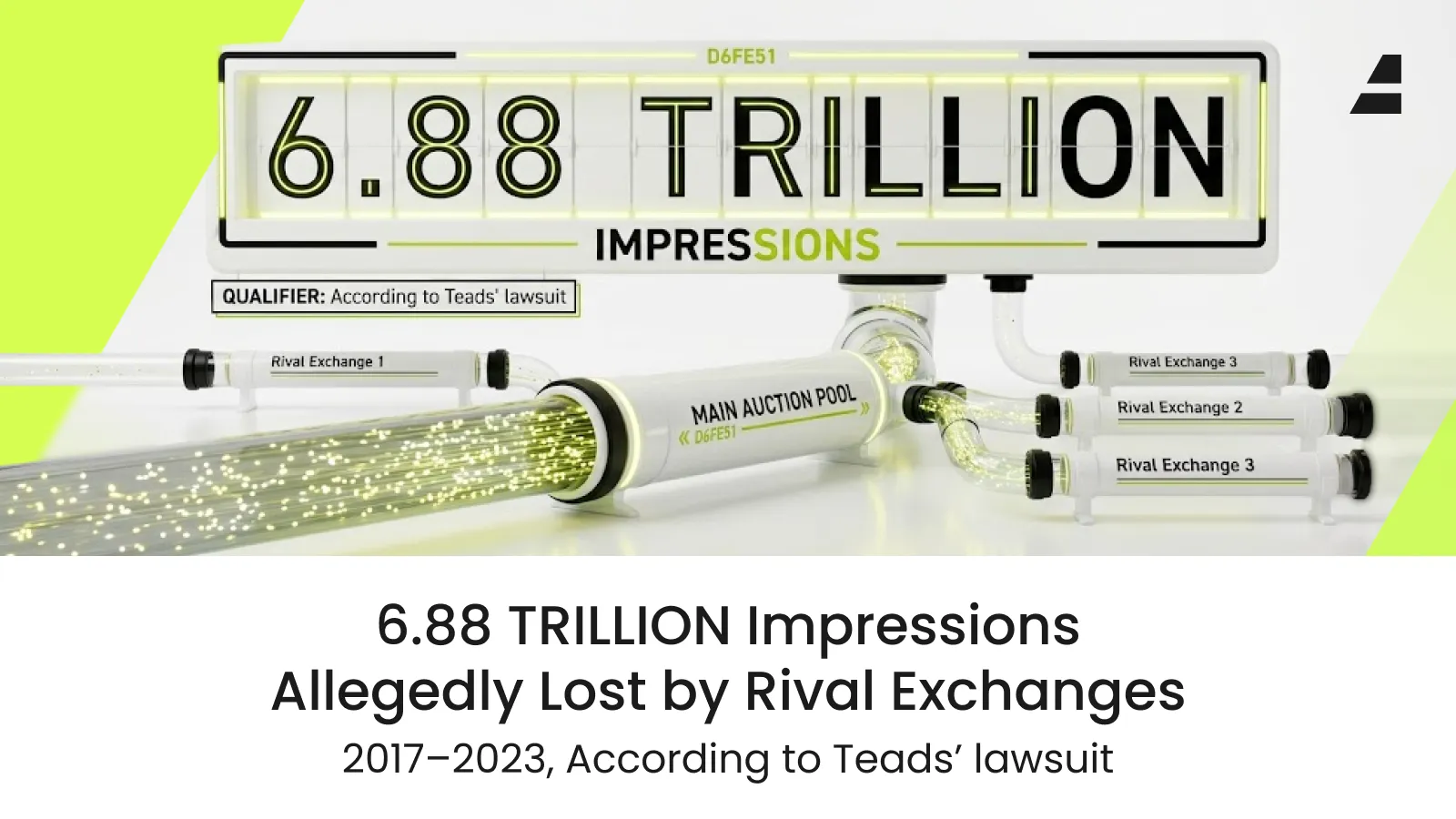
Teads estimates that rival exchanges lost access to 6.88 trillion impressions between 2017 and 2023. The figure is an allegation in the lawsuit, and the methodology behind the estimate has not been disclosed.
The Lawsuit Is Bigger Than Teads vs. Google
Teads filed its lawsuit in August 2026, seeking damages and injunctive relief related to Google's ad tech practices.
One number immediately attracted attention.
According to the complaint, Teads estimates that tying Google Ads demand to Google AdX deprived competing exchanges of approximately 6.88 trillion impressions between 2017 and 2023. That is a striking figure, but it needs context: as Adweek notes, the complaint does not disclose the methodology used to calculate the estimate.
The allegation nevertheless points to a much bigger programmatic advertising transparency issue.
Google operates technology across multiple parts of the advertising chain. Google Ads provides advertiser demand, Google AdX operates as an exchange, while Google Ad Manager provides publisher-facing technology. The question regulators and competitors have repeatedly raised is what happens when products across those layers reinforce one another.
That issue is no longer purely theoretical.
In April 2025, a US federal court found that Google had unlawfully monopolized the open-web display publisher ad server and ad exchange markets. The court also concluded that Google unlawfully tied its publisher ad server and AdX together.
Google has disputed parts of the ruling and has argued that publishers have multiple alternatives and choose its products because they are effective and affordable.
So the argument is not simply whether Google is large. Scale itself is not the problem. The harder question is whether the design of the programmatic infrastructure gives every participant a genuine opportunity to compete.
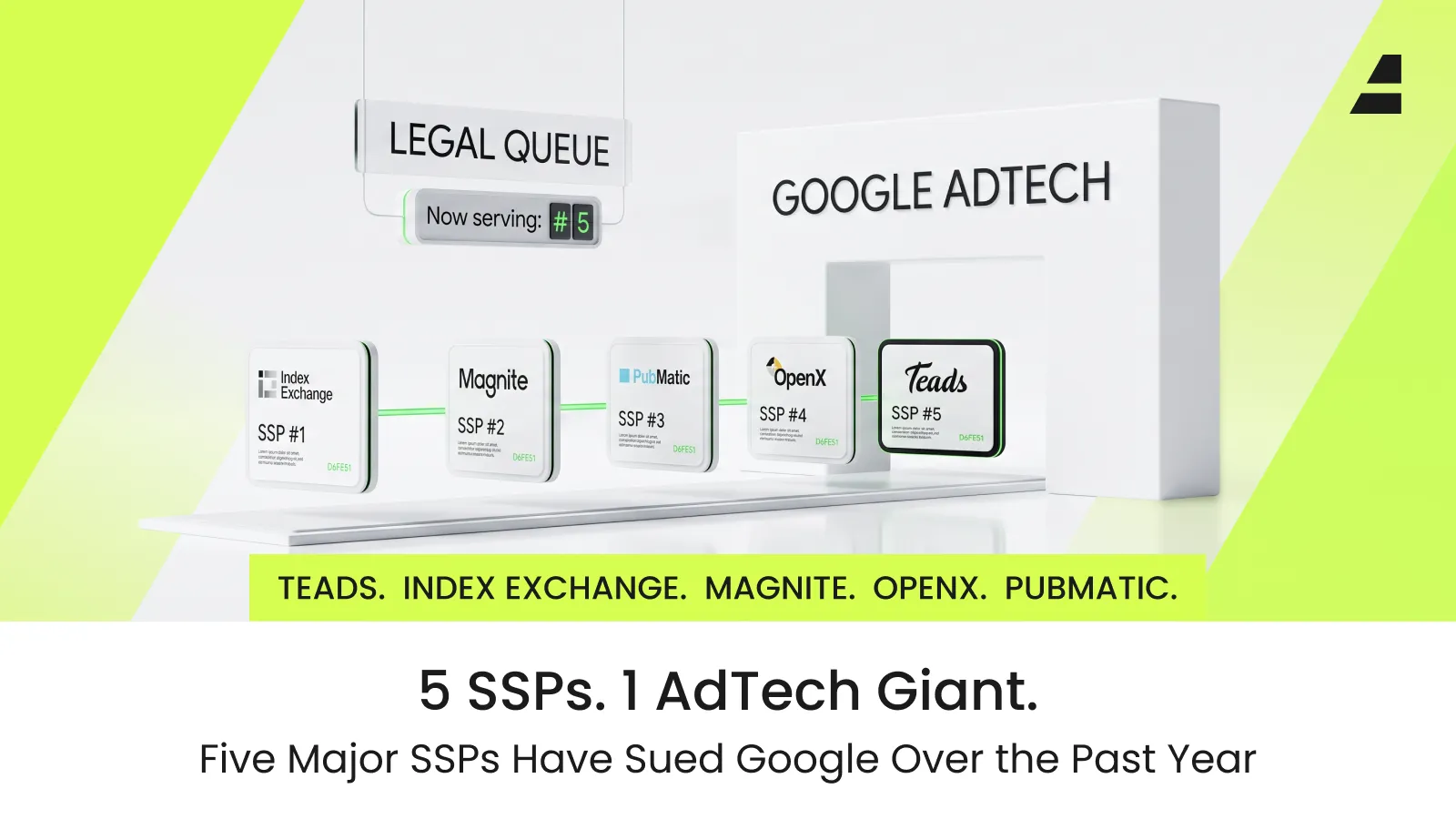
Teads joins other major SSPs that have brought legal challenges involving Google’s ad tech business, adding to the wider debate over competition in programmatic advertising.
How Auction Mechanics Shape Competition
An open auction looks straightforward from the outside.
An impression becomes available. Multiple demand sources bid. The auction determines the outcome. The publisher earns revenue, and the advertiser reaches an audience.
Behind that sequence is a much more complicated system.
Access to demand matters. Auction timing matters. Pricing rules matter. The information available to each participant matters. Even the way different platforms connect to an ad server can affect which bids have a realistic chance of winning.
This is why ad tech competition cannot be measured simply by counting how many SSPs or exchanges appear in a publisher's technology stack.
An auction can have several participants and still contain structural advantages.
For publishers, those differences can affect bid density, CPMs, fill rates, and ultimately the value of inventory. For advertisers, they can affect supply paths, costs, reach, and visibility into where media budgets actually go.
This is where the current ad tech antitrust debate becomes commercially relevant rather than merely legal.
The important question is not just: “Can another exchange participate?”
It is: “Can another exchange compete under comparable conditions?”

Auction rules can change while the underlying competition questions remain. Google’s ad tech disputes have put programmatic auction mechanics back under scrutiny.
Why Programmatic Advertising Transparency Matters
Transparency in programmatic advertising is often discussed as a reporting feature. It is much more than that.
A transparent ecosystem should help publishers understand how inventory is monetized, what demand is competing for it, and how auction decisions affect revenue. Advertisers need similar clarity around supply paths, inventory quality, fees, and campaign outcomes.
Without that visibility, optimization becomes harder.
A publisher may see a final CPM without understanding whether its setup is creating healthy auction pressure. An advertiser may see impressions and conversions without having enough insight into how efficiently the budget moved through the supply chain.
That is why supply path transparency has become such an important issue.
More intermediaries do not automatically create more competition. More integrations do not automatically create more choice. What matters is whether participants can make informed decisions and whether technology partners compete through performance, service, efficiency, and innovation.
At Afront, transparency is treated as part of performance rather than an extra reporting layer. Real-time reporting, clear metrics, granular controls, and measurable results give advertisers and publishers the information they need to make better decisions. For publishers specifically, combining premium demand with real-time bidding, yield intelligence, and transparent performance diagnostics creates more control over how inventory works.
What Independent AdTech Brings to the Open Web
The Google AdTech lawsuits also highlight something the industry occasionally underestimates: independent AdTech is not simply an alternative set of vendors.
It is part of the competitive infrastructure of the open web.
Independent platforms can create additional paths between publishers and advertisers. They can introduce different optimization models, pricing strategies, inventory relationships, formats, and service models. Most importantly, they give businesses the ability to compare outcomes rather than depend on a single technology path.
For publishers, that flexibility matters because monetization strategies are becoming more complex.
A modern publisher may combine open auctions with private marketplaces and direct deals while monetizing display, video, mobile, and CTV inventory. There is rarely one perfect demand source or auction strategy for every impression.
Afront approaches publisher monetization from this perspective. Publishers can connect through Prebid, SDK, or direct tag-based integrations and use open auctions, PMPs, or direct models according to their strategy. Real-time optimization, pricing intelligence, and transparent reporting then help turn auction activity into something publishers can actually analyze and improve.
Advertisers benefit from the same principle on the other side of the market. Granular controls, algorithmic targeting, multi-format reach, and real-time optimization are most useful when marketers can clearly understand what their campaigns are buying and what those investments deliver.
Choice becomes valuable when it is backed by visibility.
What Publishers and Advertisers Should Watch Next
The next stage of the Google ad tech antitrust story will be important, but the industry should avoid treating every lawsuit as a prediction of an immediate transformation.
Ad tech infrastructure does not change overnight.
Publishers have integrations, revenue dependencies, workflows, and technical requirements built over years. Advertisers and agencies have their own buying systems and established supply relationships. Even major legal decisions take time to move through technology stacks.
What can change faster is the standard buyers and sellers expect from their partners.
Publishers can ask harder questions about demand access, auction pressure, pricing controls, and revenue transparency. Advertisers can examine supply paths more carefully and demand clearer reporting on where their budgets travel. Agencies can evaluate technology partners not simply by scale but by the amount of control and visibility they provide.
The Teads lawsuit matters because it keeps those questions alive.
The open web does not become competitive because an auction has an “open” label. It becomes competitive when publishers have meaningful monetization choices, buyers can access quality inventory efficiently, and technology providers have a fair opportunity to compete on the value they create.
That is a much higher standard.
And it is probably the standard programmatic advertising needs.
From Mobile Advertising to the Wider Omnichannel Picture
The debate around open auctions is also part of a wider shift in how digital advertising is being built. Mobile is increasingly connected to CTV, display, video, and other environments rather than operating as an isolated performance channel.
Transparency is only part of the performance equation. Even the smartest targeting and optimization technology cannot compensate for low-quality supply. Inventory quality, viewability, publisher environments, and clean supply paths all influence what happens after an advertiser wins the auction.
Explore this connection in “Why Smarter Targeting Can’t Fix Bad Inventory: The Missing Layer in Programmatic Performance” — and why better audience intelligence delivers its full value only when it is matched with quality inventory.
Build a More Transparent Programmatic Strategy with Afront
Programmatic complexity should not mean losing sight of where your budget goes or how your inventory creates value.
Afront helps advertisers, publishers, and agencies operate across the programmatic ecosystem with advanced targeting, premium multi-format inventory, real-time optimization, and clear performance insights. Our network reaches more than 300 million unique users and delivers over 2 billion monthly ad impressions across partners in more than 150 countries.
Whether you want to improve publisher monetization, reach quality audiences across CTV, video and display, or build a programmatic strategy with greater visibility and control, our team is ready to help.
Bring your next campaign — or your inventory — to the front. Contact the Afront team to get started.
