
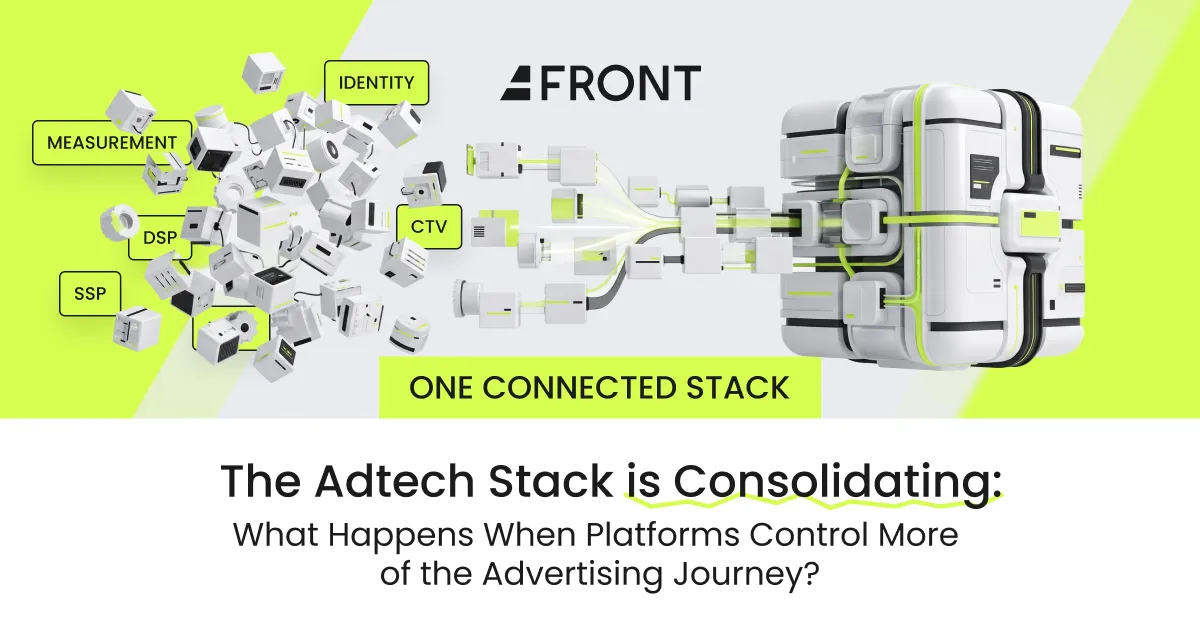
The AdTech Stack Is Consolidating: What Happens When Platforms Control More of the Advertising Journey?
AdTech was built in layers.
One platform helped advertisers buy media. Another helped publishers sell it. Other companies handled data, identity, verification, creative, attribution, measurement, and optimization.
The result was powerful. It was also complicated.
Now the industry is moving in another direction.
Platforms are bringing more of those capabilities under one roof. DSPs, SSPs, data, measurement, identity, CTV, commerce media, and AI-driven optimization are increasingly being connected inside broader technology ecosystems.
Industry analysis in 2026 describes a market moving toward fuller-stack solutions, while recent deal activity shows continued consolidation around data, measurement, monetization, CTV, and programmatic infrastructure.
There is an obvious appeal.
Fewer systems. Fewer integrations. Fewer dashboards.
But there is also a question AdTech cannot ignore:
What happens when one platform controls more of the advertising journey?
Why AdTech Became So Fragmented
The complexity of programmatic advertising did not appear by accident.
Different technologies emerged to solve different problems. DSPs gave advertisers automated access to inventory. SSPs helped publishers monetize it. Ad servers handled delivery. Data platforms improved audience decisions. Verification companies addressed viewability, fraud, and brand safety.
Over time, marketers added more tools as new channels and measurement needs appeared.
CTV arrived. Retail media expanded. Identity became harder. Privacy requirements changed how data could be used. Attribution became more complex.
The stack kept growing.
Today, that fragmentation has become an operational problem of its own. Basis reports that more than one-third of full-service and media agencies manage at least 10 tools across their AdTech stacks, more than twice the share reported in 2024.
Anyone who has worked across several advertising platforms knows the less glamorous side of that setup: different taxonomies, separate reporting systems, duplicated workflows, integration issues, and numbers that do not always agree.
Consolidation is partly an attempt to fix that.
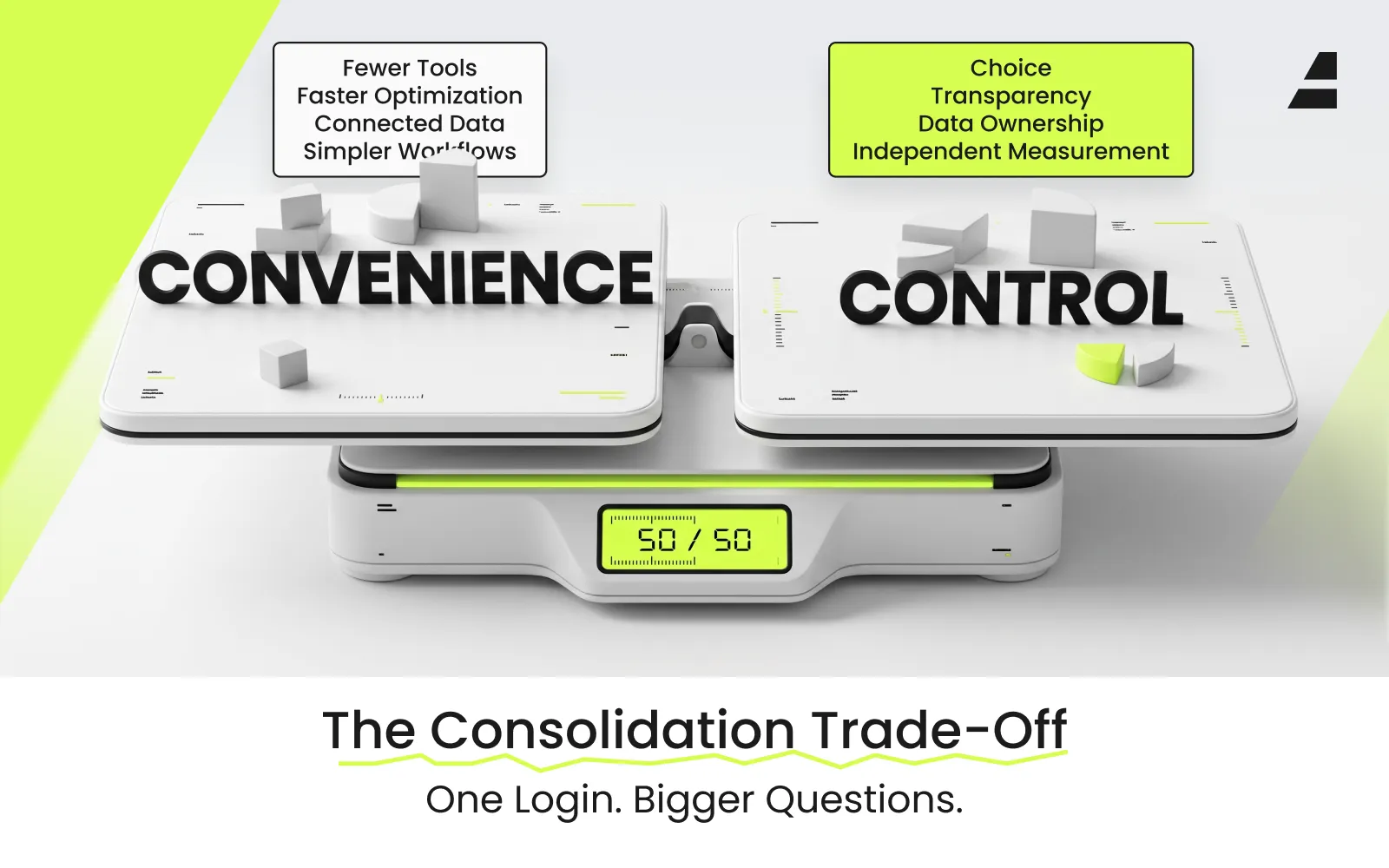 Adtech consolidation depicted as a 50/50 balance between convenience and control, with data ownership and simpler workflows.
The Appeal of the Full-Stack Platform
The pitch is easy to understand.
Why manage six systems when one platform can handle audience intelligence, activation, optimization, and measurement?
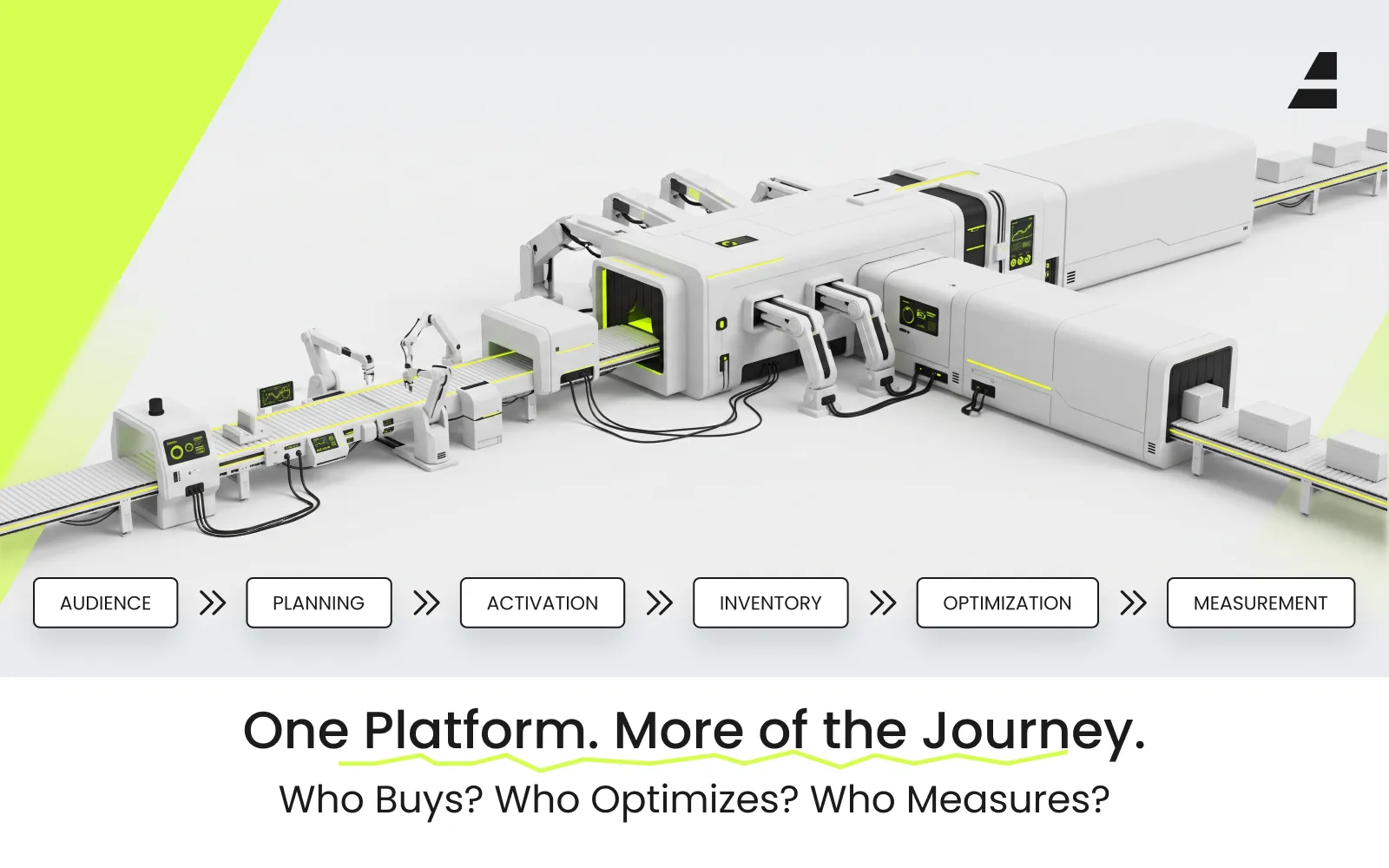 Full-stack adtech platform connects audience, planning, activation, inventory, optimization and measurement on a conveyor.
Connecting more of the advertising workflow can reduce handoffs between technologies. Campaign data can move more easily between planning, buying, and measurement. Teams may spend less time exporting spreadsheets and reconciling reports.
There can also be performance advantages.
A platform that sees more of the campaign journey potentially has more information available for optimization. Media buying decisions can connect more directly with measurement. Audience insights can feed activation faster. AI systems can learn from campaign outcomes without waiting for data to move between disconnected platforms.
That is why consolidation is not simply a corporate strategy.
There is a genuine operational problem it is trying to solve.
Fragmentation costs time and money.
Convenience Comes With a Question: Who Controls the Data?
The interesting part starts when convenience turns into dependency.
Imagine one platform controls audience data, campaign activation, inventory access, optimization, and measurement.
That creates a very smooth workflow.
But it may also mean the same ecosystem is involved in deciding where the money goes, executing the campaign, and reporting how well that campaign performed.
That is where transparency becomes important.
Advertisers need to understand which inventory they are buying, how budgets are allocated, what fees are involved, how optimization decisions are made, and how performance is measured.
Publishers need similar visibility into demand, auction dynamics, pricing, and revenue.
A simpler dashboard is useful.
A simpler dashboard with less visibility behind it is not necessarily progress.
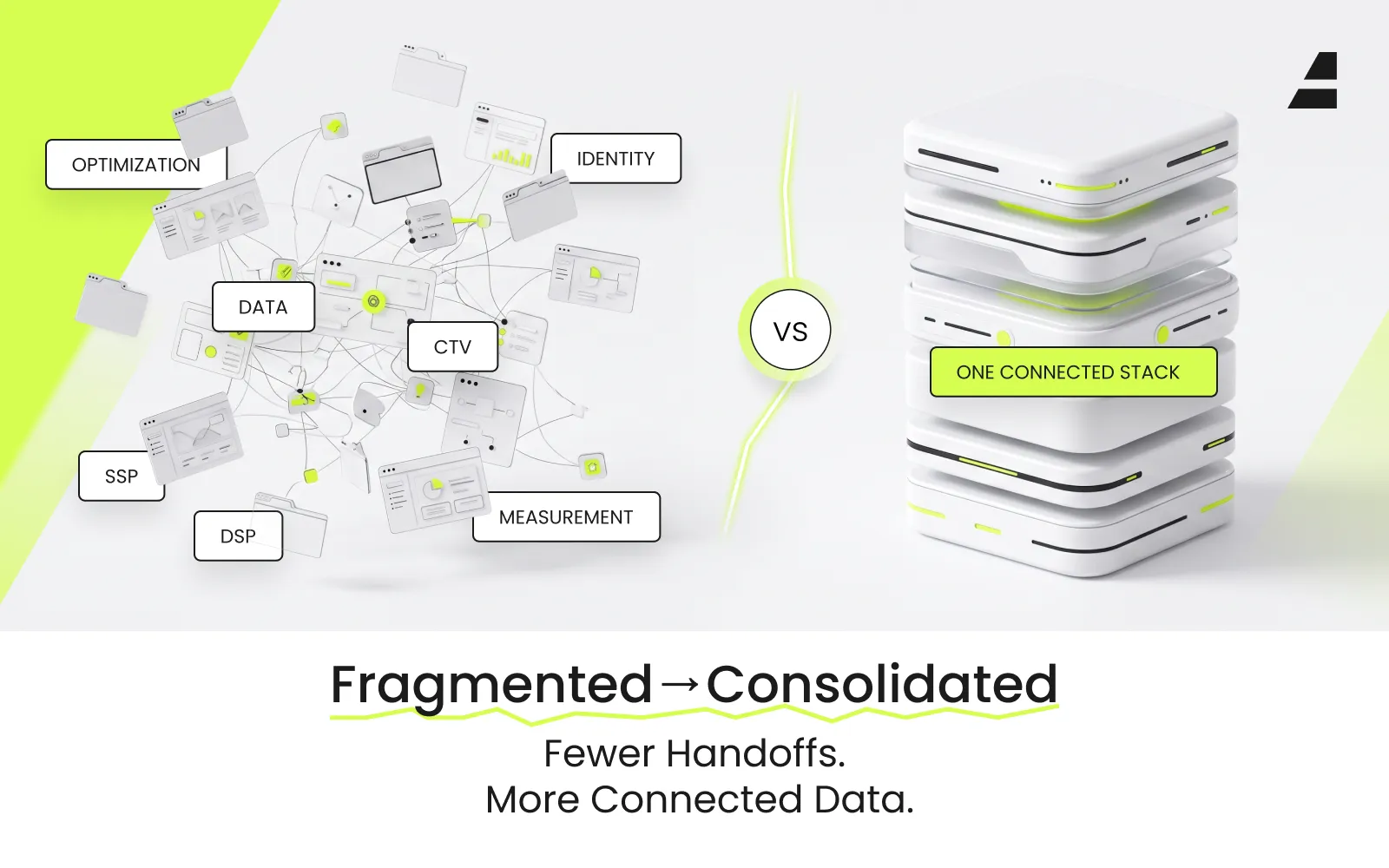 Fragmented adtech tools for data, identity, CTV, DSP, SSP and measurement contrasted with one connected technology stack.
Fewer Handoffs Can Mean Faster Optimization
There is another side to the argument.
Programmatic advertising happens quickly, and disconnected systems can slow down decision-making even when the auction itself happens in milliseconds.
Campaign teams may have targeting information in one platform, delivery data in another, attribution somewhere else, and business outcomes inside their own analytics environment.
Every gap creates friction.
More connected infrastructure can shorten that loop:
Data → activation → measurement → optimization.
That matters because modern campaigns increasingly operate across multiple environments.
CTV does not exist separately from mobile. Display does not exist separately from video. Retail media is moving beyond retailer websites. Commerce signals are influencing broader advertising strategies.
The customer journey is connected.
It makes sense that advertising technology is trying to become more connected too.
The real question is how that connection is achieved.
CTV, Retail Media and AI Are Accelerating the Shift
Three areas are making the full-stack model particularly attractive: CTV, commerce media, and AI.
CTV requires platforms to manage premium inventory, audience targeting, video delivery, measurement, and increasingly cross-screen planning.
Retail media brings first-party commerce data closer to activation and attribution.
AI adds another reason to connect the stack. Optimization systems work better when they can learn from richer signals across the campaign lifecycle.
Warner Bros. Discovery, for example, announced in 2026 that it was developing an agentic AI-driven advertising approach designed to connect planning, activation, optimization, and monetization across linear and digital inventory.
That is a useful example of where the market is heading.
The boundaries between individual AdTech functions are getting harder to see.
What Consolidation Means for Advertisers
For advertisers, consolidation can make campaign management considerably easier.
But choosing technology based only on convenience would be a mistake.
The more capabilities a platform controls, the more important it becomes to understand what is happening underneath the interface.
Can campaign performance be evaluated clearly?
Can the advertiser understand where media is running?
Can data move between systems?
Can results be independently analyzed?
Can the advertiser work with other partners if the strategy changes?
And does the platform provide genuine transparency around media costs and performance?
These questions matter because efficiency and control are not the same thing.
A platform can make media buying easier while simultaneously making the advertiser more dependent on its ecosystem.
Publishers Face the Same Trade-Off
Publishers also have good reasons to welcome consolidation.
Connecting inventory management, demand, auction intelligence, pricing, and reporting can simplify monetization.
But publishers need to protect something equally important: control over their inventory.
A publisher should understand who is buying, how demand reaches its inventory, what auction pressure looks like, and how different monetization decisions affect revenue.
This is why Afront’s publisher approach focuses not simply on generating demand, but on premium demand, transparent reporting, real-time optimization, and different programmatic transaction models. Afront supports publishers across open auctions, private marketplaces, and direct opportunities while providing real-time performance insights.
More integrated technology can be useful.
The important part is making sure integration does not become a black box.
Consolidation Does Not Have to Mean a Closed Ecosystem
The AdTech industry does not have to choose between hundreds of disconnected tools and a handful of completely closed platforms.
There is another model: connected technology that remains interoperable.
Platforms can bring targeting, buying, optimization, and measurement closer together while still allowing advertisers and publishers to understand how those systems operate and connect with external partners.
That distinction will matter more as AI takes a bigger role in campaign execution.
If an algorithm automatically changes budgets, bids, audiences, creative, and channel allocation, marketers will want to know what those decisions are based on.
Automation increases the value of transparency rather than reducing it.
The smarter the system becomes, the more important it is to understand what the system is optimizing for.
The Stack May Get Smaller. The Decisions Get Bigger.
For years, AdTech teams asked which tools they should add.
The next question may be which platforms they are comfortable allowing to control several functions at once.
That changes vendor selection.
A DSP is no longer necessarily just a buying tool. An SSP may extend beyond supply. Media owners are building advertising platforms. Commerce businesses are developing media networks. AI is beginning to connect planning, activation, and optimization.
The stack is becoming less about individual boxes on an ecosystem map.
It is becoming about who controls the connections between them.
And that makes transparency, interoperability, data ownership, and measurable performance strategic questions rather than technical details.
AI Is Changing More Than the AdTech Stack
Consolidation is only one way technology is changing the advertising journey.
AI could alter the customer side of that journey too.
Discover what happens when AI systems start helping consumers research products, compare options, and make shopping decisions In our previous article, “Advertising to AI Agents: How Agentic Commerce Could Reshape AdTech.”
Together, these shifts tell an interesting story.
On one side, advertising infrastructure is becoming more connected.
On the other, the consumer journey is gaining new AI-powered intermediaries.
AdTech increasingly has to understand both.
Connected Is Good. Transparent Is Better.
Consolidation can solve real problems.
Fewer integrations can reduce operational friction. Connected data can improve optimization. Unified reporting can make campaign management easier. AI can work across a broader set of signals.
But consolidation should not make advertising harder to understand.
The strongest AdTech ecosystems will need to combine integration with transparency, automation with control, and scale with flexibility.
That principle sits naturally within Afront’s approach. The company connects advertisers with audiences across CTV, mobile, video, and display while combining advanced targeting, real-time optimization, and transparent performance insights.
Because the objective is not to have the biggest stack.
It is to make every part of the stack work harder for the campaign.
Ready to simplify programmatic without losing visibility into performance? Afront combines premium inventory, advanced targeting, omnichannel reach, and real-time optimization to help advertisers and publishers turn complexity into measurable results.
