
The audience has already made its choice.
Streaming is becoming a bigger part of ad-supported television, while the old distinction between “TV” and “digital” makes less sense every quarter. Viewers switch between a smart TV, mobile device, streaming app and traditional broadcast without thinking about which media-buying category they have entered.
Advertisers do not have that luxury.
Behind a simple evening of watching television sits an increasingly complicated advertising market. CTV inventory is spread across platforms and publishers. Linear television still matters. The same viewer can appear across multiple environments. Frequency needs to be controlled. Targeting needs useful signals. And measurement has to tell marketers whether all those impressions actually produced something.
Streaming has changed the audience faster than TV buying has changed its infrastructure.
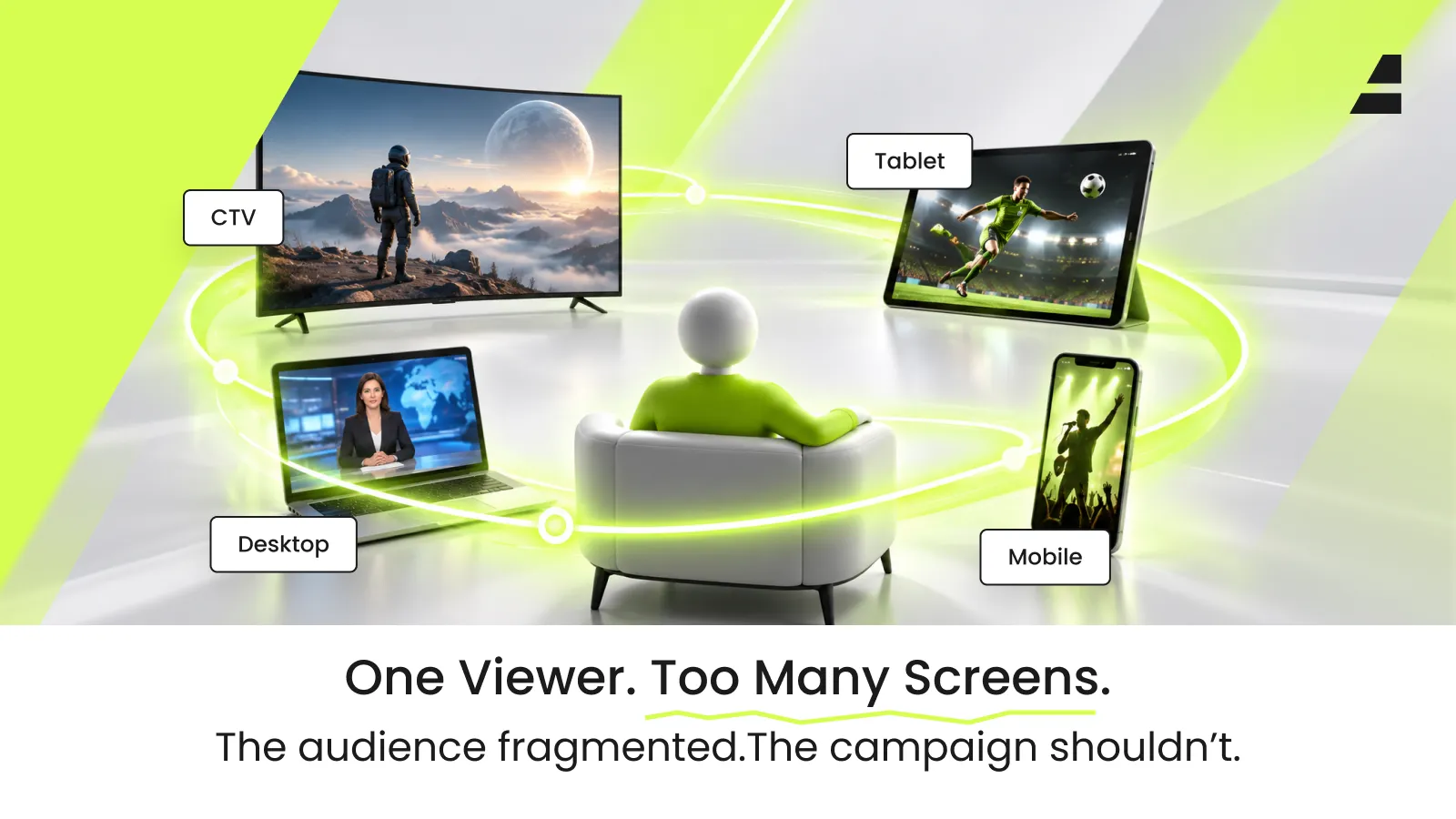
Streaming audiences move across CTV, desktop, tablet and mobile, making unified cross-screen reach and frequency management essential for programmatic advertisers.
Ad-Supported Streaming Has Crossed a Line
The numbers make the shift hard to dismiss.
According to Nielsen data reported by Adweek, ad-supported streaming represented 48.2% of ad-supported TV viewing in Q2 2026, up 1.6% during the quarter. Broadcast declined from 28.2% to 26.6%, while cable held at 25.2%.
That means streaming is now approaching half of ad-supported television consumption.
There is another detail worth noticing. Major events such as the NBA Finals and World Cup were available across both linear and streaming environments. The audience did not simply move from one type of content to another. In many cases, people watched the same premium content through a different distribution route.
For advertisers, that changes the question.
It is no longer enough to ask which channel has the audience. Brands need buying infrastructure capable of finding that audience wherever the viewing happens.
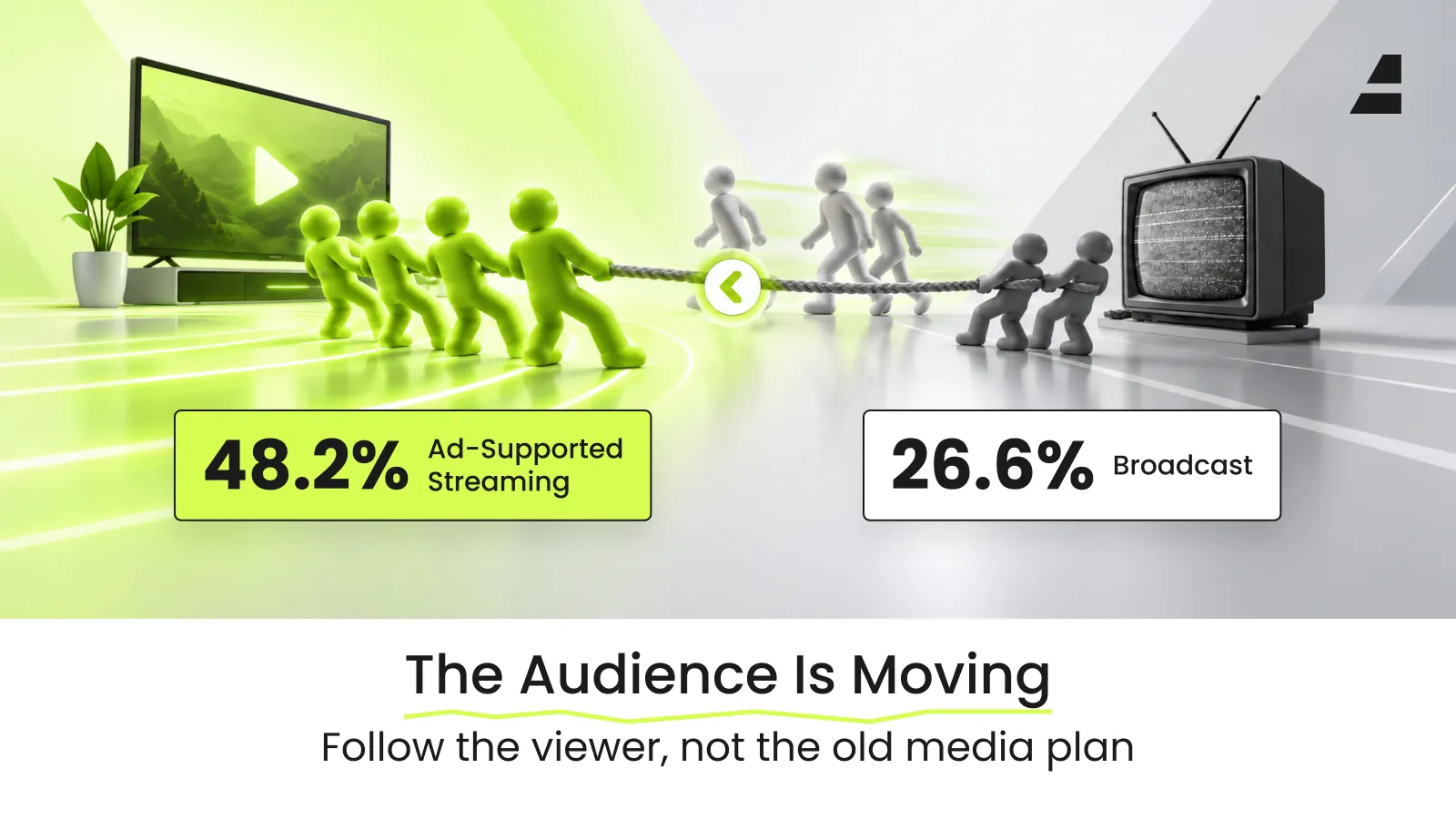
Ad-supported streaming reached 48.2% of ad-supported TV viewing in Q2 2026, compared with 26.6% for broadcast, illustrating how quickly television audiences are shifting toward streaming.
The Screen Changed. The Fragmentation Did Not Disappear.
CTV initially promised something very attractive: television’s impact combined with digital advertising’s precision.
That promise is increasingly real. The execution is still complicated.
Streaming inventory sits across apps, operating systems, device manufacturers, broadcasters, FAST services and other publishers. Free ad-supported streaming itself continues to expand. Gracenote research reported by Adweek found that the number of active FAST channels across major markets had nearly doubled since mid-2023 to more than 1,610.
More inventory creates more opportunities.
It also creates more decisions.
Buying each environment separately can quickly produce fragmented campaigns. One household might receive the same creative several times through different platforms, while another valuable audience segment gets very little exposure. Campaign teams can end up managing platforms rather than managing audiences.
Programmatic TV buying has to solve that problem.
The goal should not be to automate the purchase of more CTV impressions. It should be to make those impressions work together.
Follow the Viewer, Not the Channel
Traditional television planning was largely organized around content, networks, schedules and expected audiences.
Programmatic introduces a different logic.
Instead of beginning with “Where should we buy?”, advertisers can increasingly begin with “Who are we trying to reach?”
That sounds like a small difference. It changes almost everything.
A viewer might watch live sport through a streaming app tonight, consume FAST content tomorrow and encounter the same brand later on mobile or desktop. Treating every environment as an isolated media channel misses the way the audience actually behaves.
A better approach connects signals across the journey.
Afront’s advertiser platform is designed around this model, combining CTV, mobile, display and video with algorithmic targeting, granular controls and real-time optimization. Behavioral signals, device usage, contextual intent and other data can help advertisers move beyond broad demographic assumptions and make more relevant media decisions.
The screen matters.
The person behind it matters more.
Frequency Is Becoming a TV Problem and a Digital Problem
Fragmentation creates another familiar issue: frequency.
Reaching someone repeatedly can build memory. Reaching the same person far too often is wasted budget — and a good way to make a strong creative irritating.
The challenge becomes harder when exposure happens across several streaming services and devices.
An advertiser may see acceptable frequency inside each individual platform while the viewer experiences something completely different across the campaign as a whole.
That is why cross-channel frequency management needs to become a core part of programmatic TV strategy rather than an optional optimization.
Afront’s omnichannel approach is built to keep campaigns connected across CTV, mobile, desktop, video and display, with frequency controls and performance tracking designed to reduce wasted exposure.
The objective is not maximum repetition.
It is enough repetition to make an impact.
Measurement Has to Catch Up Too
CTV gives advertisers more measurable signals than traditional television ever could. But more data does not automatically mean clearer measurement.
Marketers can have dashboards full of impressions, completion rates, reach figures and device-level data while still struggling to answer a basic question:
Did the campaign work?
That gap becomes more important as TV moves further down the funnel.
CTV is increasingly expected to do more than create broad awareness. Advertisers want to connect exposure to site visits, engagement, conversions and other outcomes. They also want to understand how television works alongside the rest of the campaign rather than reporting it as a separate media universe.
Programmatic infrastructure therefore has to connect buying and measurement.
Real-time optimization becomes especially valuable here. When campaign data shows that one audience, environment, creative or time window is producing stronger results, budgets can respond while the campaign is still running.
A media plan should not remain static when viewer behavior is anything but static.
Linear TV Is Not Dead. The Buying Model Is Becoming Convergent.
Streaming growth does not mean advertisers should suddenly abandon linear television.
Broadcast and cable still accounted for a combined 51.8% of ad-supported TV viewing in Nielsen’s Q2 2026 figures. Broadcast was also slightly higher year over year despite its quarterly decline.
The more useful conclusion is that the separation between linear and streaming is becoming less helpful for advertisers.
Audiences do not organize themselves around media-plan spreadsheets.
They watch content.
The next stage of programmatic TV buying therefore has to be more convergent: combining premium CTV inventory, audience intelligence, cross-screen reach, controlled frequency and transparent measurement while recognizing that linear television can still play an important role.
Programmatic does not need to replace TV buying.
It needs to make TV buying behave more like the audience.
Programmatic Infrastructure Has to Become Audience Infrastructure
This is where the industry still has work to do.
Automation alone is not enough. More supply paths are not enough. More audience segments are not enough.
The real test is whether programmatic infrastructure can turn a fragmented television market into a coherent audience strategy.
Afront approaches CTV as part of a wider programmatic ecosystem rather than an isolated format. The platform provides access to premium CTV inventory alongside video, mobile and display, supported by audience targeting, real-time performance optimization and transparent reporting.
That approach operates at a meaningful scale. Afront reaches more than 300 million unique users and delivers more than 2 billion ad impressions per month across 150+ countries.
But scale is only useful when advertisers can control it.
As streaming expands, the advantage will increasingly belong to platforms and strategies that can decide where the next valuable impression should happen — rather than simply finding another place to buy one.
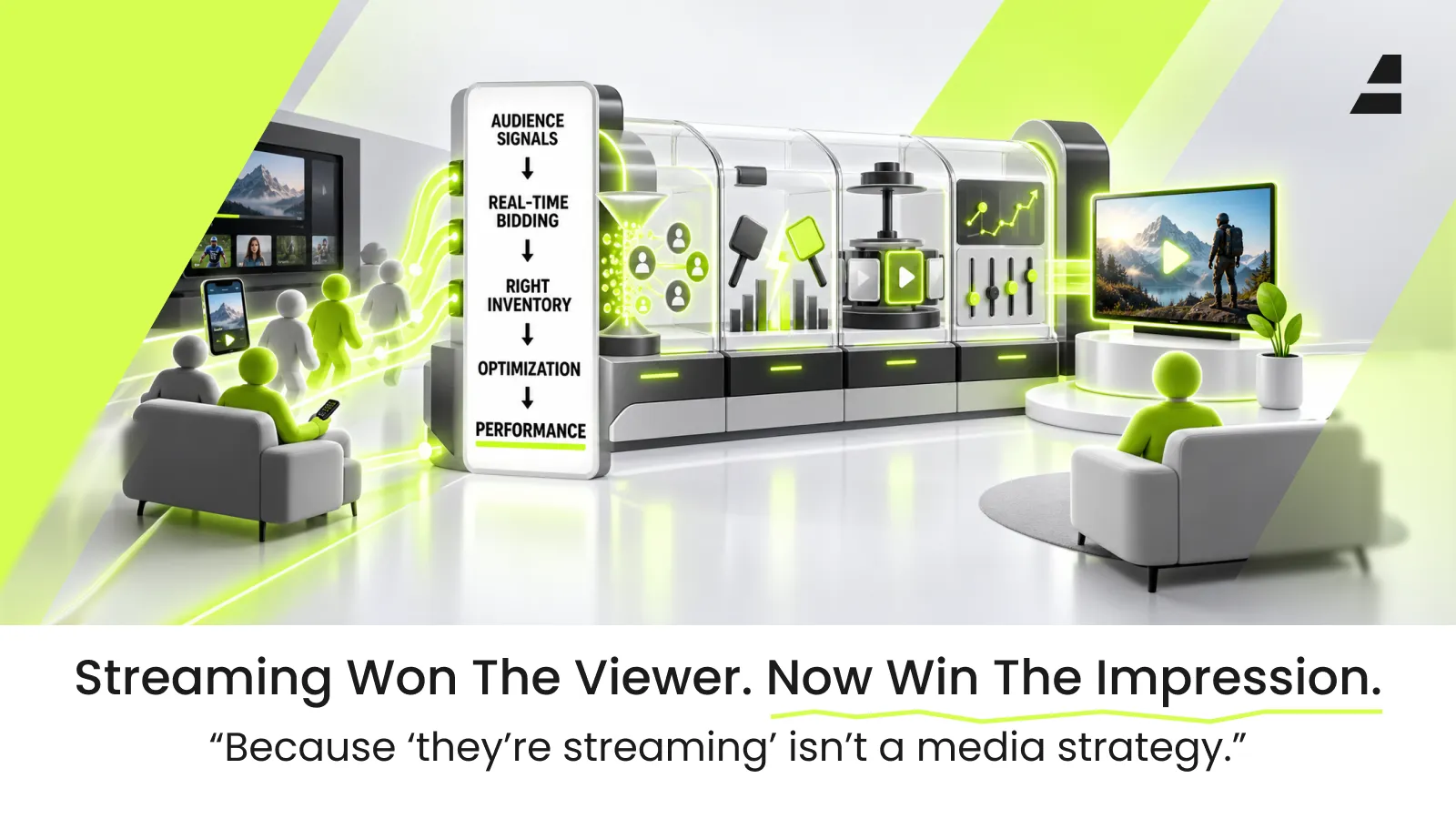
Programmatic TV connects audience signals with real-time bidding, inventory selection and campaign optimization, helping advertisers turn fragmented streaming audiences into measurable performance.
Streaming Won the Viewer. Now AdTech Has to Follow.
The transition is already happening.
Ad-supported streaming is taking a larger share of television viewing. FAST ecosystems are expanding. Premium programming increasingly exists across both linear and streaming distribution. Consumers move between screens without respecting the boundaries the advertising industry spent decades building.
Programmatic TV buying is catching up.
But the winning infrastructure will not be the one that simply offers the most CTV inventory. It will be the one that makes fragmented inventory feel like one connected opportunity: consistent audience strategy, smarter frequency, useful targeting, real-time optimization and measurement marketers can actually understand.
Streaming followed the viewer.
Now programmatic has to do the same.
Want to see how the same shift is changing consumer discovery? Read our previous article, “AI Discovery & Programmatic Advertising: What Changes?”, where we explore how AI is reshaping the starting point of the customer journey — and why programmatic advertising has to connect what happens next.
Put Your TV Budget Where the Audience Actually Is
Your audience is already moving across CTV, video, mobile and the wider digital ecosystem. Your media strategy should be able to move with them.
Afront combines premium CTV inventory, advanced audience targeting, omnichannel activation, granular campaign controls and real-time optimization to help advertisers turn fragmented viewing into measurable performance.
Ready to make your TV strategy as connected as your audience? Contact the Afront team and bring your next campaign to the front.
