
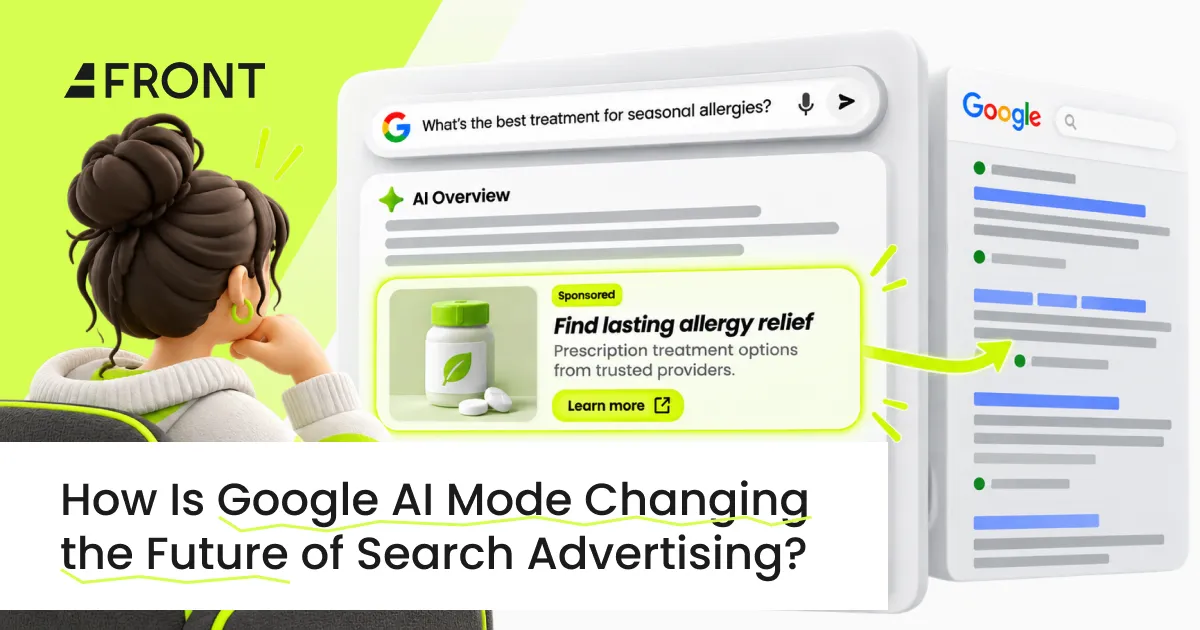

Google AI Mode is turning search advertising from a list of links into a conversation, with ads inside the answer. The latest sign came in October: Google started testing prescription drug ads in AI Mode and AI Overviews, one of the most regulated categories in advertising.
If pharma can fit inside an AI answer, almost any category can.
AI Mode already has more than 1 billion monthly users. For advertisers, that means a new place to show up. For publishers, it means fewer clicks reaching their pages.
What Is Google AI Mode and How Do Ads Work Inside It?
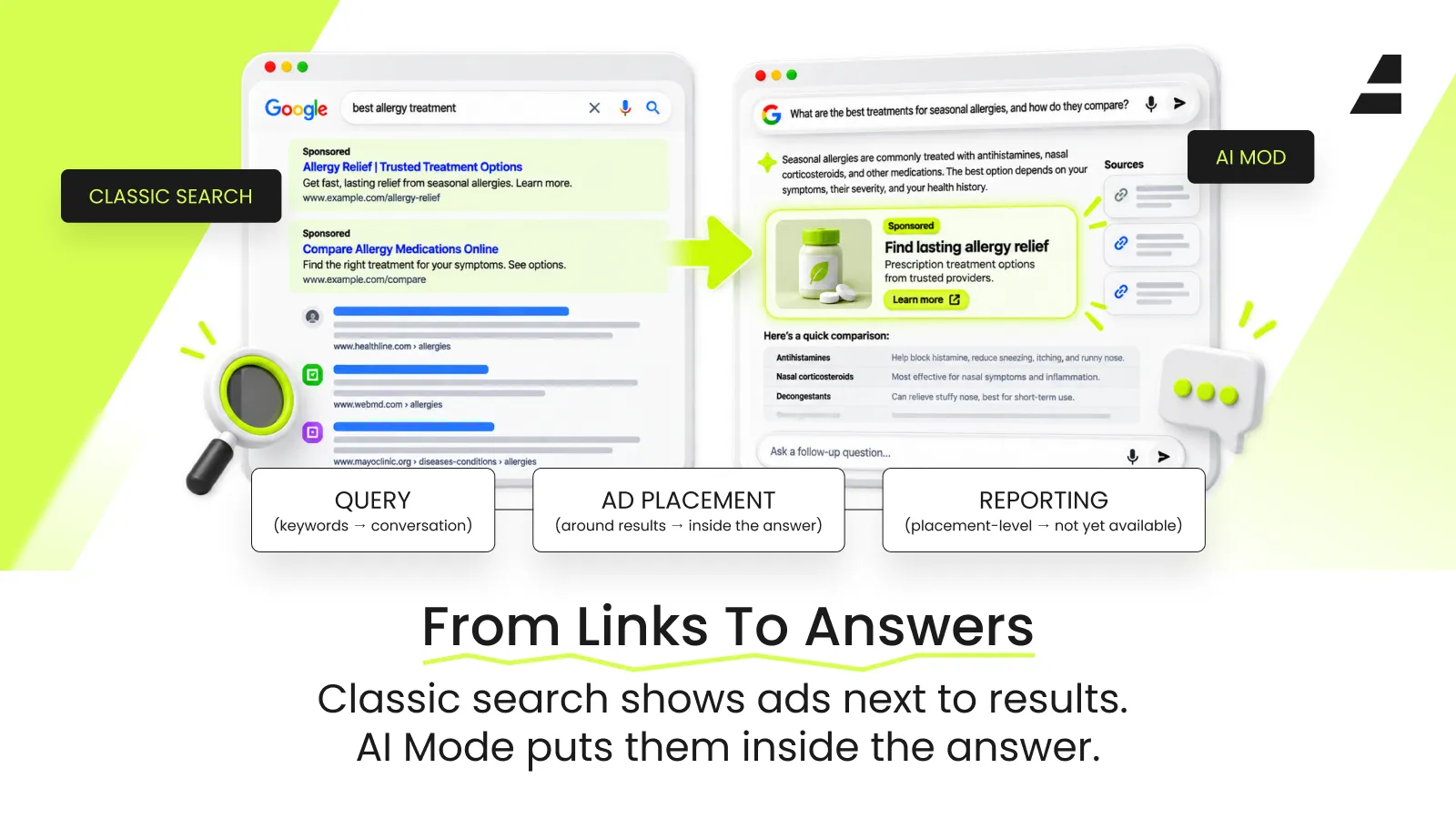
AI Mode replaces the results page with a full answer written by Gemini, and users keep the conversation going with follow-up questions. Ads appear in "Sponsored" units inside or next to that answer. Performance Max, AI Max for Search, Shopping and broad match campaigns are eligible to serve there.
Element | Classic Search | Google AI Mode |
|---|---|---|
Query | Short keywords | Long, conversational questions and follow-ups |
Result | A page of links | One AI-generated answer with sources |
Ad placement | Above and below organic results | Sponsored units inside or next to the answer |
Targeting | Keywords and match types | Intent read from the full conversation |
Creative | Fixed headlines and descriptions | Ads matched or generated to fit the question |
Reporting | Placement-level data | No separate AI Mode placement reporting yet |
1. Ads Are Becoming Part of the Answer
At Google Marketing Live in May 2026, Google introduced Conversational Discovery ads, which generate ad creative to fit a specific question, and Highlighted Answers, which place sponsored picks inside AI recommendation lists. Business Agent for Leads replaces lead forms with a chat trained on the advertiser's website. Dan Taylor, Google's VP of global ads, summed up the idea: "the best ads are just answers."
2. Sensitive Categories Are Opening Up
Healthcare ads used to be blocked from AI summaries. In May, Google began a small U.S. healthcare test that left out most prescription advertising. In October, it added branded prescription drugs, limited to standard text and Shopping ads labeled "Sponsored." Experimental formats are excluded, and existing certification rules still apply. Demand is there: AI Overviews appear for 75% of pharma-related keywords, according to Eversana.
3. Clicks Are Getting Scarcer
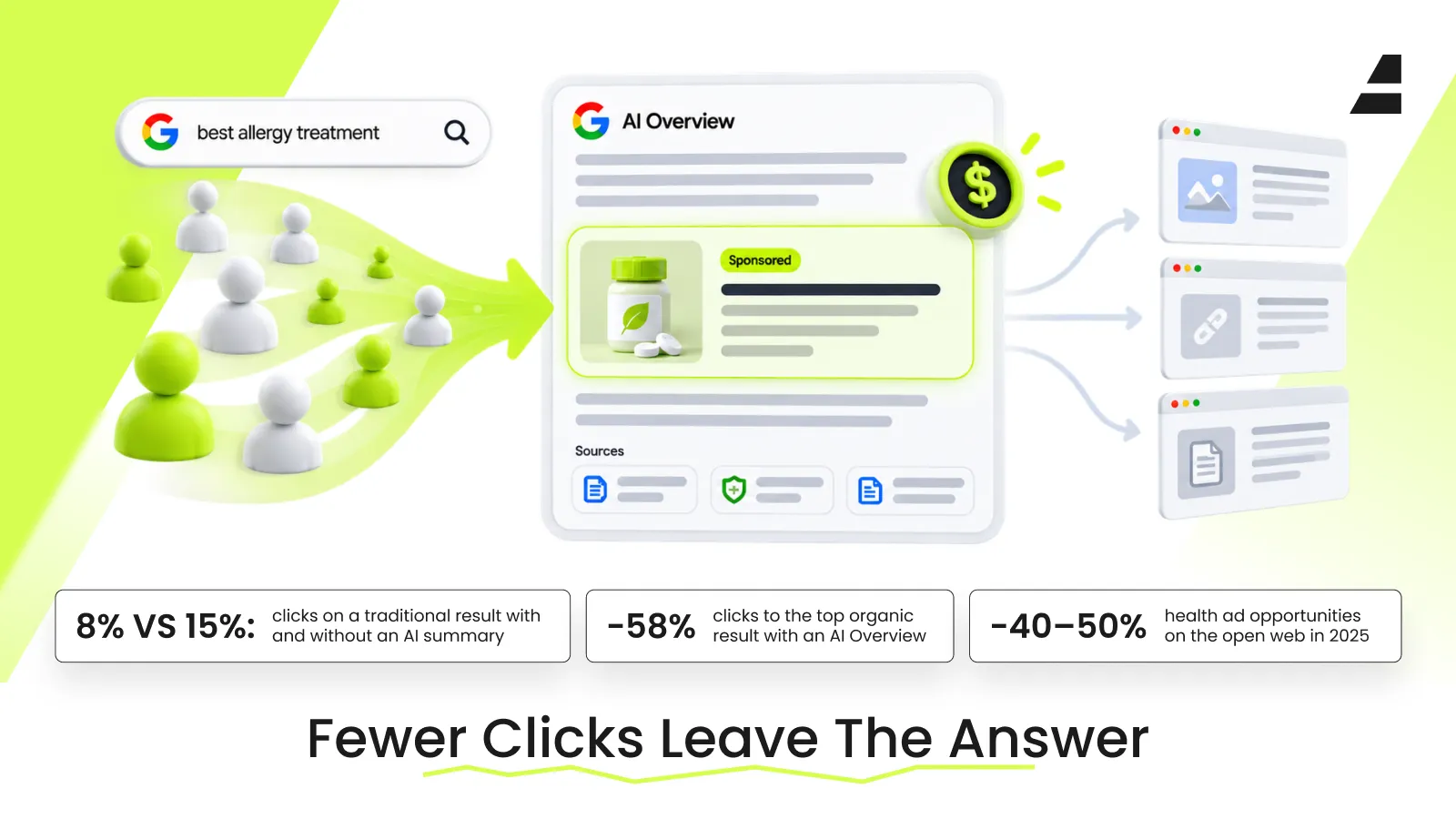
Pew Research Center found that users clicked a traditional result on 8% of searches with an AI summary, compared with 15% without one. Ahrefs estimates an AI Overview cuts clicks to the top organic result by 58%. We covered what this means for media buyers in how programmatic advertising must adapt to the new discovery journey.
Wondering where your budget should go as search changes? Let's discuss your goals and build a media mix that reaches people beyond the results page.
How AI Mode Changes Search Advertising for Advertisers and Publishers
The same shift creates new placements for brands and new pressure for the open web:
Change | What It Means for Advertisers | What It Means for Publishers |
|---|---|---|
Ads appear inside AI answers | New placements close to the decision | Fewer users click through to articles |
Intent read from full conversations | Broad match and AI Max matter more than exact keywords | Content has to be cited to stay visible |
AI generates or matches ad creative | Less control over exact ad copy | Brand safety rules need to cover AI answers |
Limited placement reporting | Harder to prove what AI Mode drives | Harder to see where traffic went |
Regulated categories enter AI answers | Pharma and health brands get a new channel | Health publishers compete harder for attention |
The money follows the answer. Search already takes about 56% of healthcare and pharma digital ad budgets, close to $18 billion this year, according to EMARKETER. Meanwhile, Index Exchange data shows health and nutrition ad opportunities on the open web fell 40 to 50% during 2025. Fewer visits mean fewer impressions to sell, which is why publishers are building apps to escape the traffic trap.
Key Drivers Behind AI Mode Advertising
Seven forces are pulling search budgets into AI answers:
Scale. AI Mode has more than 1 billion monthly users.
Longer conversations. AI Mode queries are more than doubling every quarter, and 1 in 6 is non-text.
New ad formats. Conversational Discovery ads, Highlighted Answers and Direct Offers are built for AI answers.
Commerce inside search. Merchants using the Universal Commerce Protocol can offer native checkout in AI Mode.
AI-led campaign tools. AI Max for Search left beta in April 2026, pushing more spend toward broad intent matching.
Health demand. Health accounts for about 1 billion Google searches a day, and 40% of people using AI for health research medications.
Revenue pressure. Some analysts expect Meta to overtake Google in ad revenue this year.
Together, they make AI Mode the next default placement in Google search advertising, and the ad units are still being defined.
"When I talk to advertisers this year, almost every conversation now starts with AI Mode. Their customers ask Google a question, read the answer and often never reach a website. So my advice is simple: test AI Mode, because the intent there is strong, and keep part of the budget in channels where you can see what every impression delivers." — Taisiia Bielova, CEO of Afront
How Advertisers Can Prepare for AI Mode Search Ads
AI Mode rewards advertisers who give Google better material to work with. These four steps help.
Strategy 1: Feed the System Better Inputs
AI formats build ads from what you provide. Keep product feeds, offers, assets and landing pages complete and current, so the answer has accurate material to pull from.
Strategy 2: Plan for Questions
People ask AI Mode full questions and follow-ups. Review search terms for long, conversational queries and make sure landing pages answer them clearly.
Strategy 3: Keep Compliance Ahead of the Format
The first healthcare tests excluded pinned assets and text disclaimers. Regulated brands should check how required language survives AI-generated formats before scaling spend.
Strategy 4: Balance Search With Channels You Can Measure
Google Ads does not yet offer separate AI Mode placement reporting. Keep part of the budget in CTV, video, display and in-app inventory, where every impression and outcome can be checked.
How Afront Helps Brands Grow Beyond the Search Results Page
Afront works across CTV, video, display and interstitial formats, reaching 300M+ unique users with 2B+ monthly impressions in 150+ countries. Here is how that supports a search strategy in flux:
Omnichannel reach. One platform to reach audiences on CTV, mobile, desktop and display.
Intent beyond keywords. Targeting based on behavior, contextual intent, device and timing.
Transparent reporting. Real-time dashboards, clear metrics and no hidden fees.
Brand-safe inventory. Premium placements with ad fraud prevention tools.
Ready to reach your audience wherever the search journey goes next? Let's bring your brand to the front. Contact our team today.
Final Thoughts
Google AI Mode turns search into a conversation, and ads are becoming part of the reply. Even prescription drugs now have a path into AI answers.
The opportunity for advertisers is real, but control and measurement are thinner than in classic search. The brands that do well will treat AI Mode as one high-intent channel in a wider mix and keep part of their budget where every impression can be checked.
FAQ
What are Google AI Mode ads?
They are sponsored placements inside or next to AI-generated answers in Google AI Mode. Eligible Performance Max, AI Max for Search, Shopping and broad match campaigns can serve there, with new formats such as Conversational Discovery ads in testing.
Can pharmaceutical brands advertise in Google AI Mode?
Yes, in a U.S. test that started in October 2026. Branded prescription drug ads can appear as standard text and Shopping ads labeled "Sponsored." Experimental formats are excluded, and existing certification rules still apply.
How does Google AI Mode affect clicks to websites?
AI answers reduce clicks. Pew found users clicked a traditional result on 8% of searches with an AI summary, compared with 15% without one. Publishers see less search traffic as a result.
How should advertisers prepare for AI Mode search ads?
Keep feeds, assets and landing pages complete, plan for long conversational queries, and check how compliance language works in AI formats. Balance search with channels that offer clear placement reporting.
