
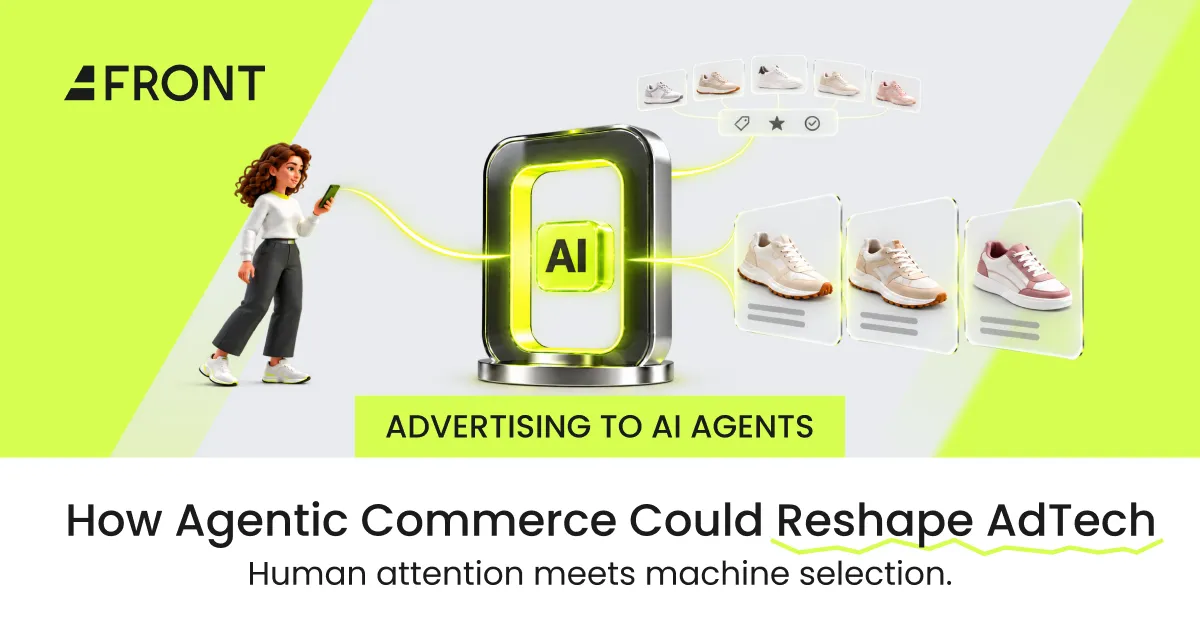
For decades, advertising has been designed to influence people.
Catch their attention. Create interest. Make the product memorable. Put the right offer in front of them when they are ready to buy.
Agentic commerce introduces another participant into that process: software.
A shopper might tell an AI assistant, “Find me a lightweight laptop under $1,000 with good battery life.” The agent can research products, compare specifications, check prices and reviews, narrow the options, and present a shortlist.
Eventually, some agents may complete more of that journey themselves.
That creates an unusual challenge for advertising.
What happens when a brand has to persuade not only the customer, but also the AI agent helping that customer decide?
This is where agentic commerce starts becoming an AdTech story.
From Search Box to Shopping Conversation
Digital shopping has already gone through several major changes.
Search engines learned what people were actively looking for. Recommendation systems predicted what they might want next. Programmatic advertising made behavioral and contextual signals actionable across huge numbers of impressions.
AI shopping agents push that evolution further.
Instead of clicking through ten product pages, a consumer can increasingly ask a conversational system to do some of the research for them.
Marketecture recently highlighted this transition from advertising that shows people what to buy toward technology that can help them choose and, potentially, shop on their behalf. Its article cites a June 2026 PwC study finding that 73% of parents planned to use AI somewhere in their back-to-school shopping journey. At the same time, research cited by Marketecture found only 11% of U.S. consumers ready to let AI actually make purchase decisions for them.
 Infographic showing 73% of consumers plan to use AI for shopping, but only 11% trust AI to make purchase decisions.
That difference matters.
People appear much more comfortable using AI for discovery and comparison than handing over the final decision completely.
For advertisers, that means agentic commerce does not suddenly remove the consumer from advertising. It adds a new layer between intent and purchase.
AI Agents Do Not Shop Like People
A person can notice a funny video ad, remember a jingle, recognize packaging, or simply decide they like a brand.
An AI system works differently.
When helping with a purchase, it may evaluate structured product information, pricing, availability, reviews, product descriptions, policies and other relevant signals.
That changes the meaning of visibility.
A beautiful campaign can make a brand memorable to a person. But if the underlying product information is incomplete, inconsistent, or difficult for an agent to interpret, that product may have a harder time entering an AI-generated comparison.
Amazon Ads describes a similar shift, arguing that brands increasingly need both rich, structured information and a presence within conversational shopping environments.
The practical implication is significant.
Creative visibility may need to work alongside machine readability.
Marketers will still need memorable advertising. They may also need to think much harder about whether their products can be accurately understood by the systems assisting consumers.
Product Feeds Could Become Media Assets
Product feeds have traditionally been treated as fairly functional pieces of ecommerce infrastructure.
Title. Price. Category. Image. Availability. Product attributes.
Agentic commerce could make that information much more strategically important.
If AI systems are comparing products before presenting recommendations, then clean and accurate product data influences whether a brand can be understood correctly in the first place.
This is already visible in the direction major commerce platforms are taking.
Google introduced the Universal Commerce Protocol in January 2026 and announced additional Merchant Center attributes designed to help retailers participate in agentic shopping experiences. Shopify has also announced support for commerce across AI channels through the same protocol.
OpenAI, meanwhile, expanded its Agentic Commerce Protocol in March 2026 to support richer product discovery and comparison experiences in ChatGPT.
Different platforms may take different approaches, but the broader direction is becoming visible: structured commerce information is moving closer to the discovery experience.
For AdTech, that creates an interesting overlap between media, product data, and commerce infrastructure.
Targeting Could Start Looking Different
Programmatic advertising has spent years getting better at identifying the right person.
Behavior. Device. Geography. Context. Interests. Intent.
Agentic commerce raises a different targeting question.
What if part of the opportunity is understanding the request being delegated to the agent?
Consider the difference between:
“I need new shoes.”
and:
“Find running shoes under €150 that are comfortable for daily running.”
The second request contains rich commercial intent.
Budget, use case, product category and desired features are already present.

Traditional product search vs. AI shopping assistant using budget, comfort, and delivery preferences to find running shoes.
That could make conversational commerce a particularly valuable environment for relevant commercial recommendations. Amazon, for example, is already experimenting with conversational and agentic advertising experiences that introduce product or brand information within shopping conversations.
For advertisers, the challenge will be relevance without intrusion.
An AI shopping experience that simply recreates banner clutter inside a chatbot would miss the point. Advertising has to add useful information at the moment a decision is being formed.
Creative Still Matters — Just Differently
It would be easy to conclude that agentic commerce makes branding less important.
That would be premature.
An AI agent might create the shortlist, but humans still bring preferences, memories, emotions and brand perceptions into the final decision. And current evidence suggests many consumers remain hesitant to delegate purchases completely.
Imagine an agent recommends three running shoes.
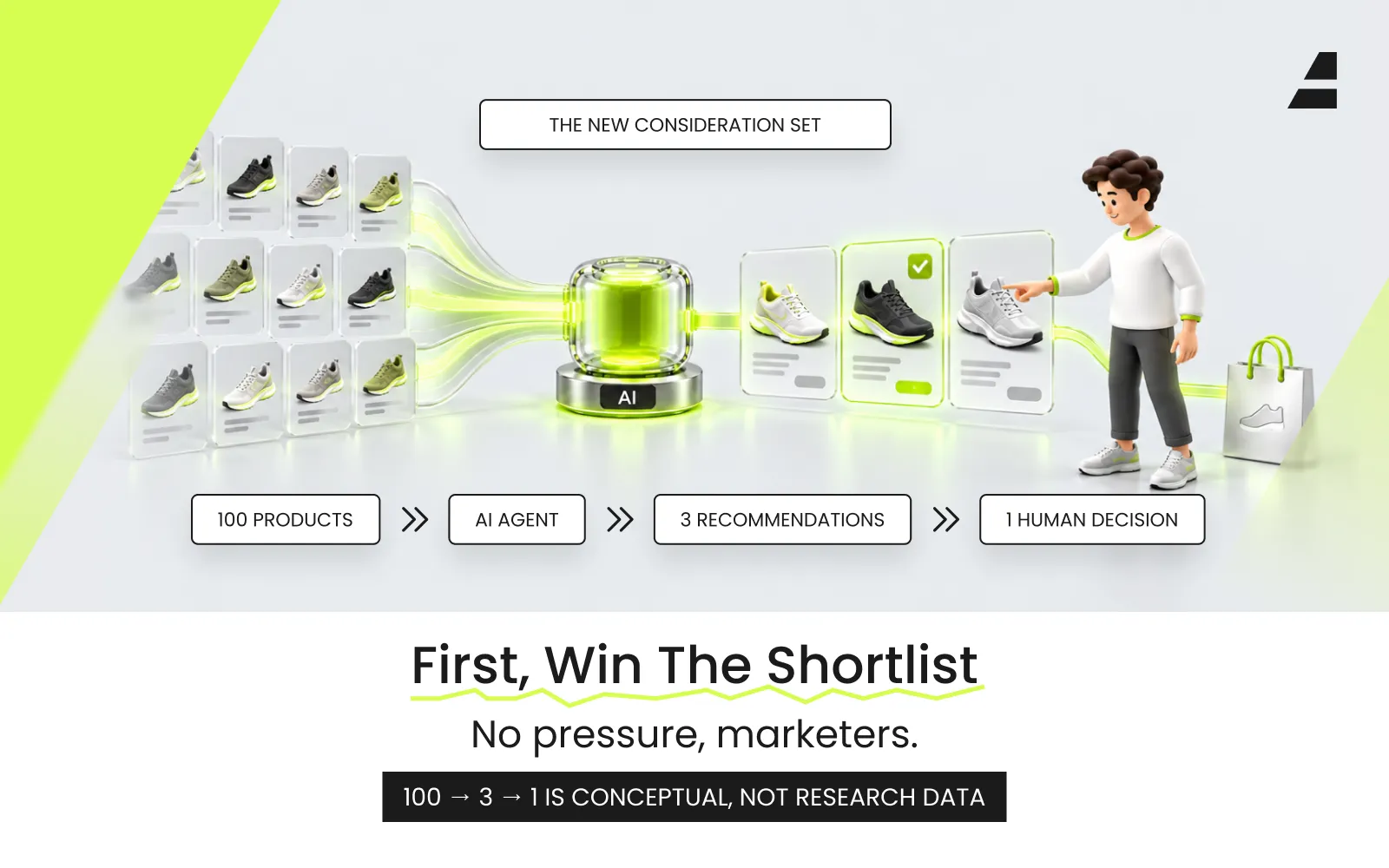 AI shopping agent filters 100 products into three personalized recommendations before a shopper makes the final purchase decision.
One is a brand the consumer knows and likes. Two are unfamiliar.
The recommendation matters. So does everything the consumer experienced before asking the agent.
This creates two jobs for advertising.
Be understandable to the machine. Be desirable to the human.
Performance marketing and brand advertising therefore do not disappear in an agentic environment. Their relationship may become more interesting.
Creative builds memory and preference. Structured information helps products enter consideration. Programmatic technology helps brands reach audiences across the wider journey.
The strongest strategy may need all three.
Measurement Gets More Complicated
Agentic commerce also creates a difficult attribution problem.
Suppose someone sees a CTV campaign on Monday. They encounter a display ad on Wednesday. On Friday, they ask an AI assistant to compare products. The agent recommends the advertised brand, and the shopper purchases it.
What deserves the credit?
The AI recommendation?
The CTV impression?
The display campaign?
The product information that helped the agent select the brand?
Probably not one thing alone.
That is why the growth of agentic commerce could make cross-channel measurement even more important. Marketers will need to understand how awareness, discovery, recommendation and conversion interact instead of treating the final touchpoint as the entire customer journey.
For programmatic advertising, this reinforces something the industry already knows: the closest signal to the purchase is not necessarily the only signal that created it.
AdTech May Start Optimizing for Two Audiences
Afront’s current advertising approach is built around reaching relevant audiences across environments including CTV, mobile, display and video, with advanced targeting and real-time performance optimization.
Agentic commerce adds another consideration to that model.
Brands may increasingly need to think about how advertising influences the human while product and commerce data inform the systems assisting that human.
That does not mean DSPs suddenly start “targeting robots.”
The shift is subtler.
AdTech may have to connect more closely with commerce infrastructure, conversational interfaces, product data, first-party signals and new forms of high-intent context.
The customer remains the customer.
But the path to that customer is changing.
From Smarter CTV Auctions to Smarter Commerce
This evolution is part of a broader change happening across programmatic advertising.
CTV is developing auction mechanics designed specifically for streaming environments. Commerce platforms are becoming media platforms. AI systems are becoming discovery interfaces.
The common thread is infrastructure adapting to how people actually consume media and make decisions.
Find out another side of that evolution in our previous article, “Why Pod Bidding Could Be the Next Efficiency Upgrade for CTV.”
Pod bidding and agentic commerce may look like completely different subjects. But both point toward the same reality: digital advertising infrastructure cannot stand still while consumer behavior and media environments change around it.
Advertising May Need to Win the Recommendation
Agentic commerce is still developing, and fully autonomous shopping is far from universal. Current consumer research suggests the transition will be gradual rather than immediate.
But the direction deserves marketers’ attention now.
Advertising has always competed for attention.
Search competed for intent.
Retail media moved advertising closer to transactions.
Agentic commerce could introduce another contest: being selected for consideration by the systems helping consumers make decisions.
That does not eliminate great creative, audience strategy or programmatic execution.
It makes their coordination more important.
For brands, the next challenge may be surprisingly simple to describe:
Be remembered by the person. Be understood by the agent. And be ready when the two make a decision together.
Afront helps advertisers reach high-quality audiences across CTV, video, display and mobile with advanced targeting, premium inventory and real-time optimization. If your customer journey is getting more complex, your programmatic strategy should be getting smarter with it.
